


TL;DR
- Lovable is great for rapid demos, but many teams hit limits at roles, migrations, and integrations.
- Choose tools by stage: prototype speed vs production stability, ownership, and infra.
- AppWizzy favors production readiness with real infra, repo ownership, and lower rewrite risk.
- Developer-centric options (Bolt, Replit) give control; V0 is UI-only; Fine trades control for convenience.
- Use a framework of 7 questions to avoid lock-in and rewrites as traction grows.
Fact Box
- Over 60% of early-stage startups underestimate technical debt introduced during rapid prototyping.
- Lovable often generates React/Next UIs and uses managed services such as Supabase for auth, data, and backend.
- AppWizzy outputs a production-ready codebase: repo you own, VM runtime, real database, auth, hosting, and deploy flow.
- Bolt.new is an in-browser IDE where AI writes and edits files; full code, deps, and file tree are visible and editable.
- V0 by Vercel is a UI generator for React/Next; it does not build backend, auth, databases, or full-stack apps.
Lovable can get you an app in minutes, but minutes are cheap. The real cost shows up months later, when your “AI-built MVP” meets real users, real data, and real business constraints.
Most people searching for Lovable alternatives are really asking a different set of questions:
- Is Lovable good enough for production, or just for demos?
- What happens when I need roles, migrations, billing logic, or integrations?
- Will I own my code, or be forced into a rewrite?
- Which AI app builder won’t collapse once users start paying?
As Paul Graham famously put it: “Startups don’t die because they fail to build a prototype. They die because they can’t turn a prototype into a real product”.
And this is no longer a niche problem. Recent industry analyses from organizations like Gartner and McKinsey show that while AI dramatically reduces initial development time, over 60% of early-stage startups underestimate the long-term cost of technical debt introduced during rapid prototyping. Multiple SaaS postmortems point to the same pattern: tools optimized for speed often break down at the exact moment teams need stability, onboarding first customers, handling permissions, migrating schemas, or passing security reviews. The problem isn’t that AI app builders don’t work. It’s that most of them stop working precisely when things start to matter.
By reading this article, you’ll understand what Lovable is actually good at, where it realistically breaks, and which Lovable alternatives make sense depending on your stage, from idea validation to real production software. You’ll learn how tools like AppWizzy, Bolt, Replit, and others differ not just in features, but in philosophy: demos vs production, abstraction vs ownership, speed vs survivability. Most importantly, you’ll leave with a clear framework to choose an AI app builder that fits your startup or SMB today, without sabotaging it tomorrow.
What is Lovable?
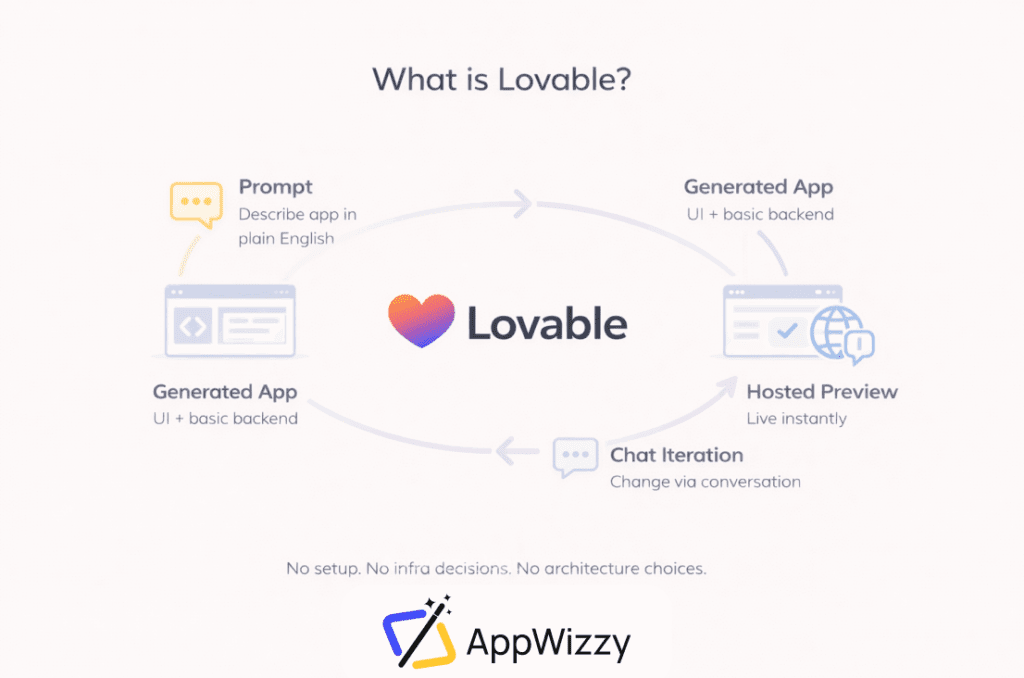
Chat → App: The Core Lovable Promise
Lovable can be summarized in one simple idea: describe an app in natural language and get a working product almost immediately. There’s no environment setup, no framework selection, and no architectural decisions pushed onto the user. You write what you want, Lovable builds it, and within minutes, you’re interacting with a real interface.
This reduction of friction is not incremental, it’s radical. The distance between idea and execution is effectively compressed into a conversation. For many founders, especially non-technical ones, this explains the initial “wow” moment that makes Lovable feel revolutionary.
What Lovable Actually Generates Under the Hood
Although the experience feels abstract, Lovable relies on a fairly standard modern web stack. The frontend usually resembles a React or Next.js application with utility-first styling, while authentication, database access, and basic backend logic are handled through managed services such as Supabase. Deployment is fully managed, so every generated app comes with a hosted preview that’s instantly accessible.
Iteration happens in the same conversational loop. Ask for a new screen, adjust a flow, or change copy, and the system regenerates the app accordingly. From the user’s perspective, there’s no distinction between “design,” “backend,” or “deployment”, it all feels like a single action. That illusion of simplicity is intentional, and when it works, it’s incredibly effective.
Why Founders Fall in Love with It So Quickly
Lovable removes the most psychologically difficult part of building software: starting. There’s no blank screen, no waiting for a developer, no uncertainty about whether the idea can even be visualized. Founders can validate ideas immediately. Designers can prototype without engineering bottlenecks. Product teams can align on something tangible rather than abstract specs.
For demos, early MVPs, hackathons, pitch meetings, and internal tools, Lovable delivers exactly what people want: speed, clarity, and momentum. It’s not just about saving time, it’s about reducing hesitation. When progress is visible within minutes, people move forward instead of overthinking.
When Real Products Start to Push Back
The moment an app leaves the “demo” phase, reality introduces new constraints. Users create messy data. Roles and permissions stop being simple. Schema changes become unavoidable. Integrations fail in unexpected ways. Billing logic grows edge cases. These aren’t rare enterprise problems, they’re normal consequences of success.
At this stage, Lovable’s abstraction can become restrictive. The generated structure is optimized for fast creation, not long-term evolution. Changes that would be trivial in a hand-built codebase can feel disproportionately hard. Teams often find themselves negotiating with the tool instead of building features. The app still works, but iteration becomes less predictable and less comfortable.
The Hidden Boundary Most Teams Discover Too Late
Lovable excels at answering one question extremely well: “Can this idea exist?”
What it doesn’t optimize for is the next question: “Can this system grow safely?”
That distinction is subtle but critical. Lovable isn’t broken when teams hit this boundary, it’s simply revealing its intended scope. The problem arises when a prototyping engine is treated as a long-term production foundation. This is usually the point where teams start searching for Lovable alternatives, not because Lovable failed them, but because their product outgrew the stage it was designed for.
Understanding where that boundary lies is the key to using Lovable correctly and to choosing the right tool for what comes next.
Lovable Alternatives
Lovable is excellent at one thing: getting you to “something that works” extremely fast. The tools below exist because many teams eventually need more, more control, more structure, more safety when the product stops being a demo. These are the strongest Lovable alternatives today, depending on how far you plan to go.
AppWizzy
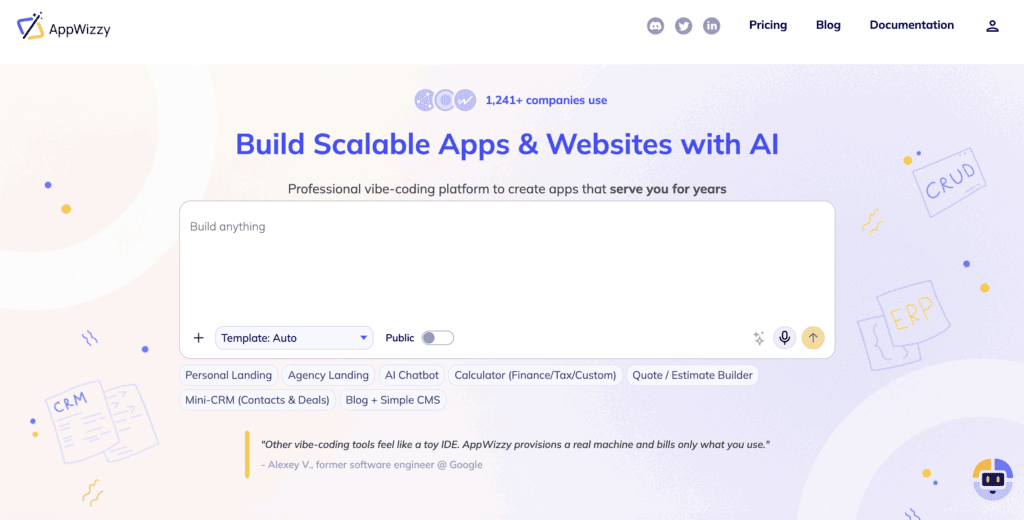
AppWizzy approaches the problem from the opposite direction of Lovable. Instead of asking “how fast can we generate something visible?”, it asks “how fast can we generate something real“? AppWizzy acts less like a chatbot and more like an AI software engineer that translates intent into a structured, production-ready application.
When you build with AppWizzy, the result isn’t just a UI preview. You get a real application running on real infrastructure: a virtual machine, a real database, authentication, hosting, and a Git repository you fully own. The AI doesn’t freestyle code line by line. It produces a schema, applies deterministic generation rules, and outputs a codebase that follows consistent architectural patterns. That difference matters once the app grows.
This makes AppWizzy especially well-suited for founders and small teams who want MVP speed without falling off the rewrite cliff. SaaS products, admin panels, internal tools that may evolve into customer-facing software – these are the kinds of projects where AppWizzy shines. You can start fast, but you’re not painting yourself into a corner.
The trade-off is intentional friction. AppWizzy asks you to think a bit more about structure up front. That means it’s not always as instantly flashy as Lovable for a pure demo. But in return, you get predictability, ownership, and a codebase that another engineer can actually understand three months later.
Compared to Lovable, AppWizzy wins on production readiness, infrastructure control, and long-term maintainability. Lovable can still be faster for a same-day pitch demo. But if you care about deployments, database migrations, permissions, and not starting over later, AppWizzy is the safer first choice.
If you care about deploys, databases, migrations, and ownership, start here.
Banani.co
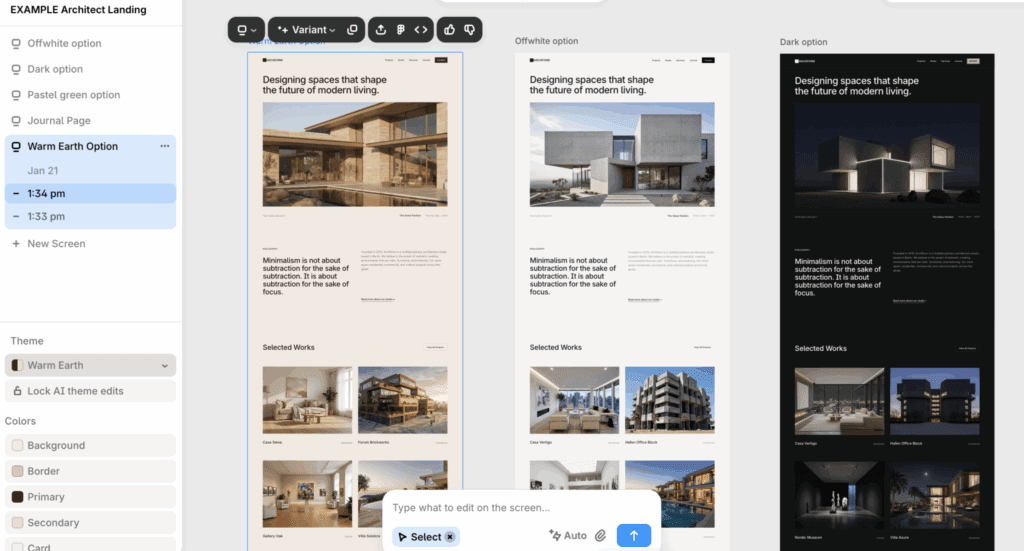
Banani sits one step before most builders. It doesn’t try to ship an app. It helps you decide what the app should be before you commit to building anything.
You give it a text prompt or a screenshot, and it generates editable UI designs on a canvas. Multiple screens at once, side by side. You can tweak layouts visually, explore variations fast, and export to Figma when you’re ready to hand off or move into implementation. The point is focus. Nocode, no backend, no deployment – by design. Banani is useful when the real bottleneck isn’t engineering speed, but arriving at a UI direction that’s actually worth building. If your team keeps changing its mind, or you need something concrete to align on, this tool can save a lot of wasted build cycles.
Banani doesn’t replace a full app platform. It makes the next step cleaner by removing uncertainty upfront.
Vitara AI
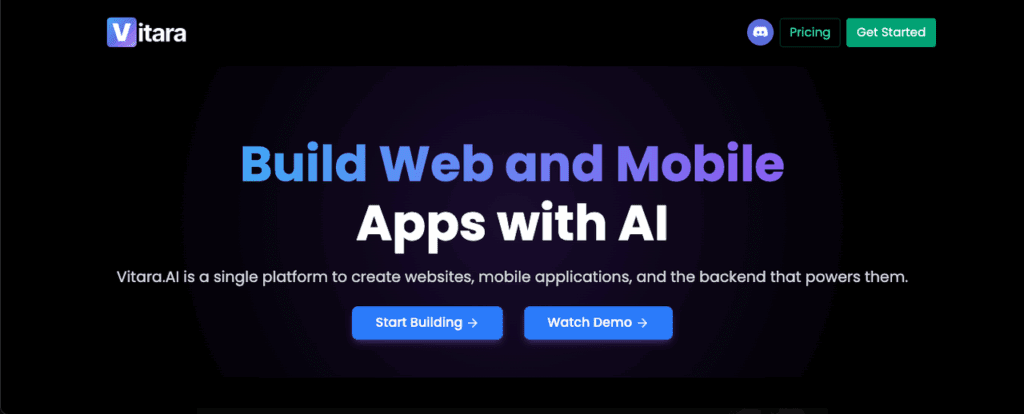
Vitara AI lands in that middle ground between quick demo builders and real dev tools. You describe your app in plain language, and it generates a full-stack app with frontend, backend, and database. It gives you speed without starting from scratch. What makes it different is code access. You’re not locked into a black box, you can edit, export, and build on top of the generated code. That matters once your app starts getting real users and complexity.
When you compare lovable with Vitara, you will find Vitara.ai leans more toward actual product building, not just demos. Compared to AppWizzy, it still depends more on generated structure than long-term architecture. It’s best when you want speed with some level of control.
Bolt.new
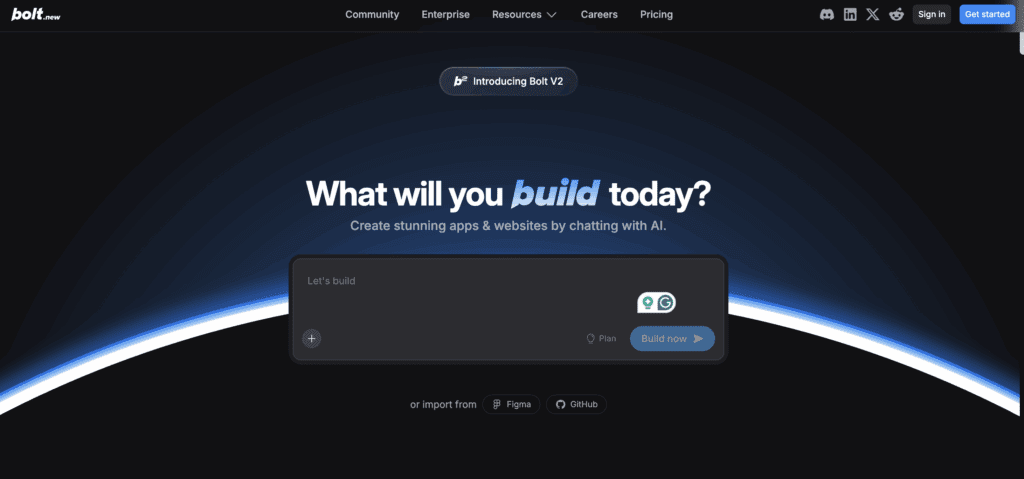
Bolt.new sits in a different category. It’s not a no-code tool pretending code doesn’t exist. It’s an in-browser development environment where AI actively writes and modifies your files while you watch.
Bolt feels familiar to developers because it exposes everything. The file tree, the dependencies, the code itself , nothing is hidden. You prompt the AI, it generates code, and you can immediately edit it by hand. This makes Bolt appealing to builders who want acceleration but refuse to surrender control.
The strength of Bolt is flexibility. You can build web apps, sometimes even mobile apps, using popular frameworks and deploy them wherever you want. The weakness is that flexibility comes with responsibility. You’re still “driving” the project. If something breaks, you or the AI need to debug it. There are fewer guardrails.
Compared to AppWizzy, Bolt offers more manual control and immediacy for developers who enjoy living in code. AppWizzy, by contrast, trades some of that freedom for a more guided, production-oriented pipeline. Bolt is a great choice if you’re hands-on and want AI as a copilot. AppWizzy is better if you want AI to handle architecture decisions consistently across projects.
Replit
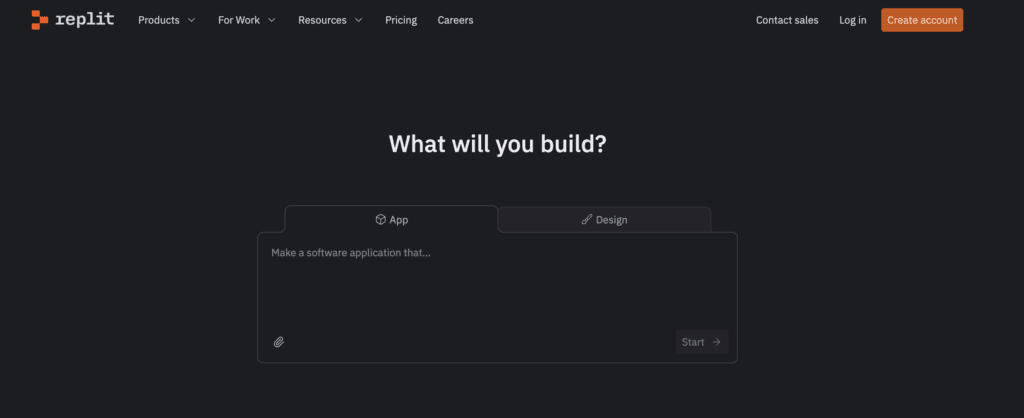
Replit is not a traditional app generator, but it earns its place here because of how many teams use it as one. With its AI assistant layered on top, Replit becomes a powerful environment for building apps quickly without local setup.
Replit’s biggest advantage is breadth. It supports dozens of languages, real-time collaboration, and instant hosting. Teams can spin up prototypes, internal tools, or even production apps without worrying about environments. The AI helps write code, explain errors, and refactor logic, but it doesn’t hide the underlying complexity.
That’s also the limitation. Replit assumes you’re comfortable with an IDE. Non-technical founders will struggle. It won’t give you a polished product from a single prompt the way Lovable does.
Compared to AppWizzy, Replit is a flexible workshop, while AppWizzy is a guided factory. Replit excels when developers want freedom and collaboration. AppWizzy excels when teams want a repeatable path from idea to production-ready system with less manual coordination.
V0 by Vercel
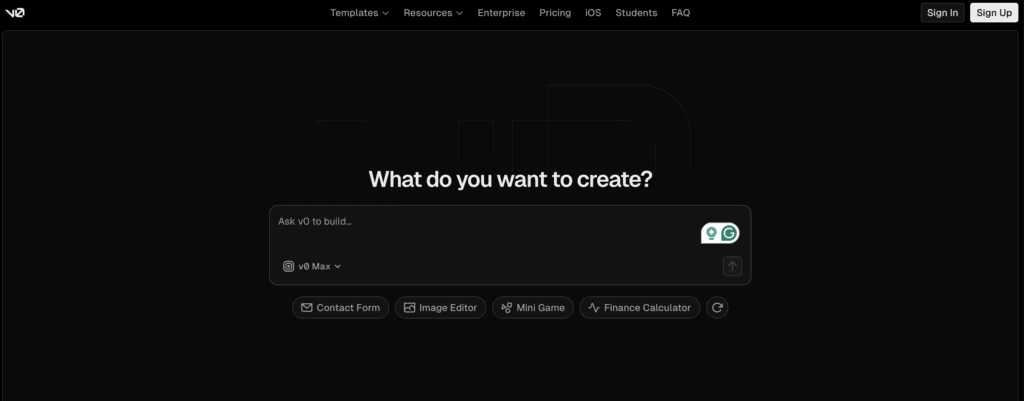
Vercel‘s V0 is often mentioned in the same breath as Lovable, but it solves a narrower problem. V0 is a UI generator, not a full app builder. You prompt it for interfaces, and it outputs clean React components, typically optimized for the Next.js ecosystem.
For frontend teams, this is incredibly useful. You can generate complex layouts, dashboards, and forms in minutes, all aligned with modern design systems. What V0 does not do is backend logic, authentication, databases, or deployments beyond the frontend.
V0 works best when paired with something else. Many teams combine UI generators like V0 with AppWizzy or Replit: one tool handles structure and backend, the other accelerates interface work. Compared to AppWizzy, V0 isn’t an alternative, it’s a complement.
Fine.dev
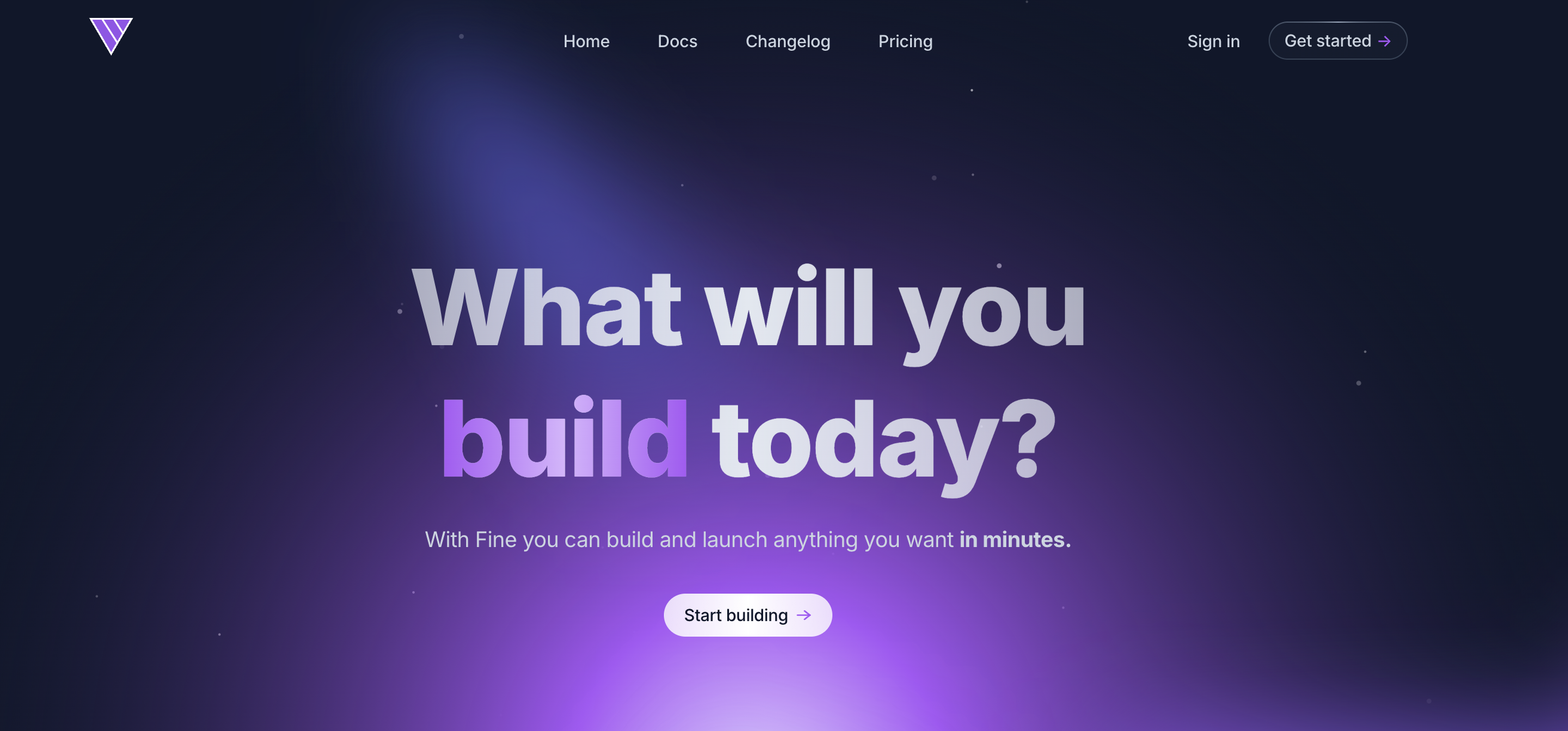
Fine.dev targets a similar audience to Lovable: non-technical founders who want an app without dealing with code or infrastructure. Fine stands out by building everything on top of Cloudflare’s ecosystem, offering global deployment and managed backend services by default.
This makes Fine appealing for simple SaaS tools or internal apps that need to be live quickly and scale reasonably well. The downside is opacity. Much of the logic is abstracted away, and migrating away from the platform can be difficult if your needs change.
Compared to AppWizzy, Fine trades control and portability for convenience. It’s excellent for early-stage validation, but riskier for long-term ownership.
Pythagora
Pythagora is for teams that care less about “pretty instantly” and more about “does this architecture survive contact with reality.” It’s closer to an engineering automation tool than a no-code app builder. Instead of mainly generating UI, Pythagora leans into planning, backend structure, and making changes in a way that doesn’t collapse the project.
Where it shines is when your app has real logic: workflows, integrations, background tasks, and non-trivial data relationships. It’s not the fastest “demo machine,” and it’s not designed for non-technical founders. But for developers who want AI to do serious scaffolding, and potentially help with debugging and iteration, it’s a credible option. The downside is that it still requires developer judgment. If you don’t know what good architecture looks like, you won’t know when the AI is taking shortcuts.
Pythagora is more “AI engineer” than “AI designer.” If you’re already building real software and want acceleration, it’s interesting. If you want a product demo in 10 minutes, it’s not the tool.
Meku
Meku sits in the same general neighborhood as Lovable, but it’s aimed more at builders who want code-first ownership and the ability to work like a normal developer after generation. It’s the kind of tool you use when you want that “prompt-to-app” speed, but you don’t want to feel trapped in a walled garden.
Meku is usually positioned around generating modern React-style apps with a sensible structure, quickly. It’s useful for founders with some technical ability, indie hackers, and small teams that want to generate a base product and then take over with normal coding workflows. The big benefit is portability: your project feels more like a standard repo you can continue building in, rather than a magical artifact that only makes sense inside one platform.
The trade-off is obvious: because it’s more code-centric, it’s less forgiving for non-coders. You’ll get speed, but you still need engineering instincts to keep it clean and stable as you iterate.
Meku is “prompt-to-codebase” with fewer handcuffs, good for technical founders who want momentum and control.
Capacity
Capacity is a more narrowly focused alternative that tends to appeal to teams living in the Next.js + TypeScript world. Think of it as a fast scaffold generator that helps you spin up a proper web app foundation without doing the repetitive setup yourself.
Its main value is that it helps you get to a sane baseline quickly, routing, layouts, basic pages, and often integrations you’d normally wire by hand. Unlike pure “chat-to-demo” tools, Capacity is usually designed for people who will traditionally continue development after the initial generation. That makes it a strong fit for dev teams and agencies that don’t want to reinvent boilerplate for every project.
The downside is scope. Capacity won’t feel magical if you expect a fully designed product from a single prompt. It accelerates development, but it doesn’t replace development. If your goal is to generate a complete SaaS with auth, billing, complex permissions, and deployments handled automatically, you’ll likely need additional tooling (or pair it with a more full-stack, production-first platform).
Capacity is the “serious Next.js starter on steroids.” Great if you ship Next.js products and want speed without chaos.
The Pattern Behind All Lovable Alternatives
The real difference between these tools isn’t AI quality or feature checklists. It’s philosophy.
Some optimize for speed to first demo. Others optimize for survival after the demo works. Lovable sits firmly in the first camp. AppWizzy is deliberately built for the second. The right choice depends less on how fast you want to build today and more on whether you want to still be building the same product six months from now.
TL;TR Comparison Table: Fast Decision in One Screen
| Tool | Best For | Production readiness | Code ownership | Infra included | Learning curve | Typical “rewrite risk” |
| AppWizzy | Startups/SMBs building past MVP (SaaS, internal tools, admin panels) | High (built to survive real data + changes) | Full (repo-first mindset) | Yes (VM + DB + hosting/deploy flow) | Medium | Low (designed to avoid the cliff) |
| Lovable | Non-technical founders who need a demo/MVP fast | Medium (great early, strain later) | Partial (export exists, but often messy) | Yes (hosted preview, managed backend) | Low | High (common once complexity grows) |
| Bolt.new | Developers who want AI inside an IDE and hands-on control | Medium-High (depends on your discipline) | Full | Partial (dev environment + deploy options) | Medium-High | Medium (you can avoid it, but you must drive) |
| Replit (+AI) | Dev teams, collaboration, multi-language prototyping | Medium-High (if you engineer it) | Full | Partial (cloud runtime, hosting options) | Medium-High | Medium (depends on team quality) |
| V0 (Vercel) | Frontend/UI acceleration for Next.js teams | Low (UI only, not a full product) | Full (generated components) | No (not a full stack) | Low-Medium | N/A for “rewrite” (you still need backend) |
| Pythagora | Devs wanting structured generation for real logic | Medium-High | Full | No/Partial (varies; you assemble infra) | High | Medium (less rewrite, more engineering work) |
| Meku / Capacity | Developers who want fast scaffolding + code-first flow | Medium | Full | No/Partial | Medium | Medium (solid base, but you still build the product) |
| Fine.dev | No-code builders who want all-in-one convenience | Medium | Low-Partial | Yes (platform-managed) | Low | Medium-High (depends on platform limits) |
How to Choose the Right Tool (For Startups & SMBs)
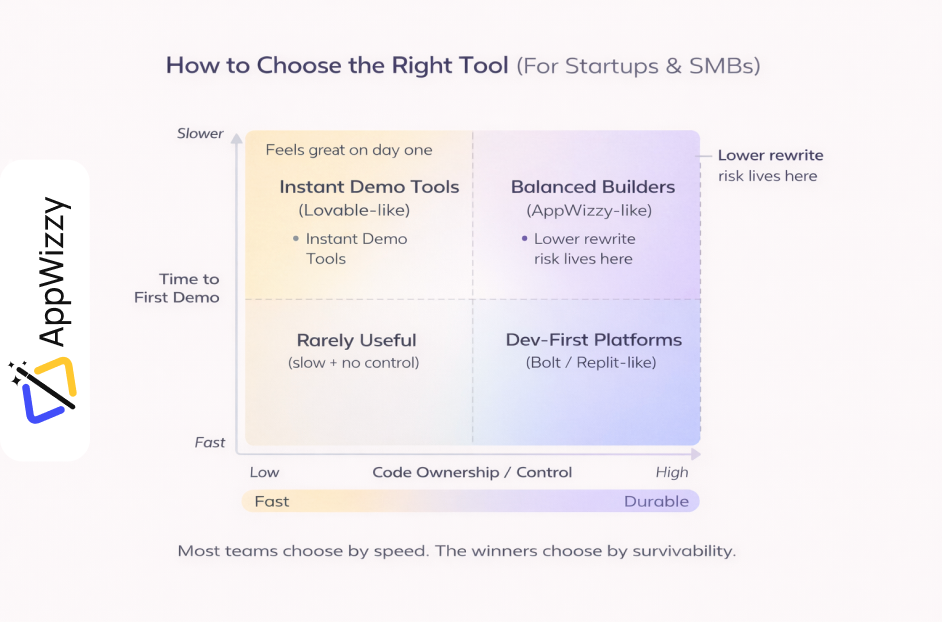
7 Questions That Decide Everything
- Do you need code ownership, or are you okay with lock-in?
If you’ll ever hire developers, raise funding, or sell to businesses that ask, “Can we self-host?”, ownership becomes non-negotiable. If you’re validating an idea and don’t care yet, lock-in can be a fair trade for speed. - Multi-tenant SaaS or a single internal tool?
Internal tools can live with shortcuts. Multi-tenant SaaS punishes shortcuts: permissions, data isolation, billing, audit logs, and migrations become the real product. - How complex are roles/permissions?
“Admin/user” is easy. “Manager can edit only their region, finance can view but not edit, contractors can comment, customer can invite teammates” is where toy stacks start to crack. - Are there real integrations?
Stripe, SSO, webhooks, CRM/ERP, email providers, background jobs, scheduled tasks, and integrations turn “app builder” into “software engineering.” Choose a tool that doesn’t panic when the world shows up. - Who maintains this in 3 months, you or a dev team?
If it’s “future developers”, your output must be readable, testable, and structured. If it’s “still me”, you might accept more abstraction for speed, but understand the debt you’re taking. - Do you need CI/CD + environments?
The moment you have real users, you want dev/staging/prod separation, rollbacks, migrations, and predictable deployments. If your tool can’t support that, it’s not a production path. - What’s your tolerance for a rewrite?
If you can afford to rewrite after traction, prototype tools are fine. If a rewrite would kill momentum (or money), pick production-first from day one.
The Stuff Nobody Tells You
A demo that “works” can be the most expensive thing you ship, because it convinces you you’re closer to product than you really are. Demo-ready is not production-ready. Production is where the boring problems live: migrations, auth edge cases, permission explosions, data integrity, rate limits, observability, and rollbacks.
The hidden cost is rarely the subscription. It’s the day you change your data model and realize everything is coupled. It’s the first enterprise prospect asking for SSO and audit logs. It’s the first payment dispute. AI tools feel cheap right up until they deliver you a codebase that nobody wants to maintain.
The brutal truth: the biggest “AI app builder” differentiator is not how fast it generates your first version. It’s how gracefully it handles your second and tenth versions.
Recommended Picks by Persona
Non-technical solo founder
Start with Lovable for speed and clarity. Use it to validate the idea, run user interviews, and get early feedback fast. The moment you see traction (or you start caring about roles, billing, data ownership), plan the transition to a production path.
Tech founder / small dev team
Pick AppWizzy if you want speed and a foundation you can keep building on without regret. Pick Bolt.new if you want maximum hands-on control and you’re happy living in an IDE while the AI accelerates you.
Agency building client apps
Choose AppWizzy when the client expects ownership, handoff, and long-term maintainability. Choose Replit when you’re collaborating with a dev-heavy team and need flexibility across stacks and fast iteration together.
SMB internal tools
Use AppWizzy when the internal tool might become business-critical (permissions, reliability, scaling) or when you’ll need to integrate with existing systems. Add a UI tool like V0 if you want the interface to move faster than the backend.
Summing Up
Lovable isn’t the villain of this story. It’s one of the reasons AI app builders became mainstream at all. It proved that software doesn’t have to start with weeks of setup and boilerplate. For prototypes, demos, and early validation, it does its job exceptionally well.
The problem begins when teams confuse speed to the first version with readiness for real use.
Every successful product eventually collides with the same realities: messy users, evolving data models, growing permission trees, integrations that fail, billing edge cases, security reviews, and the need for predictable deployments. These aren’t signs of failure. There are signs that the product is working. And they’re exactly the moment when tools optimized purely for generation start to show their limits.
That’s why Lovable alternatives exist, not because Lovable failed, but because products outgrow the stage it was designed for.
Some teams need maximum abstraction and minimal friction. Others need code ownership, infrastructure control, and a foundation that won’t collapse under iteration. Tools like AppWizzy, Replit, Pythagora, Meku, Capacity, and Fine all sit at different points on that spectrum. The difference between a good and a bad choice isn’t features, it’s fit.
The most important takeaway is simple: choose your tool based on who will maintain the product later, not who is building it today.
If you’re validating an idea, optimize for speed. If you’re onboarding paying users, optimize for stability. If you’re building something meant to last, optimize for ownership and evolution.
AI has made building software faster than ever. It hasn’t made software simpler, it has just moved the hard decisions further down the road. The teams that win are the ones that see that road coming and choose tools that won’t force them to turn back.
Build fast. But more importantly, build something you won’t have to rebuild.