


TL;DR
- AI web app builders can ship a prototype in minutes, but the wrong choice can cost months when you go production.
- Prototype-first tools optimize for speed and visuals; production-ready platforms optimize for stability, control, and scaling.
- For real launches, prioritize SEO, analytics, reliable editing, deployments, and GitHub export for developer handoff.
- AppWizzy and Replit target production workflows; Lovable and Bolt target fast MVPs; Base44 is no-code with built-in logic.
- Ask: “What happens after week two?”—real users, integrations, and iteration expose demo-only limitations.
Fact Box
- AppWizzy includes native GitHub export and import for developer handoff.
- Lovable supports exporting generated projects directly to GitHub.
- Bolt.new can open projects in StackBlitz and sync with GitHub via StackBlitz.
- Vercel v0 is UI-focused and does not generate backend or app logic.
- The article warns a wrong AI builder choice can cost months after an initial minutes-fast launch.
AI web app builders can launch a site in minutes, but choosing the wrong one can cost you months. Read this article to the end to learn how to tell a flashy demo from a platform that’s actually ready for your business.
When people search for the best AI web app builders, they’re usually asking the same questions:
- Will this tool help me launch faster, or just create a nice-looking demo?
- Can I scale this site when my business grows?
- What happens when I need real customization or developer support?
- Am I buying speed now at the cost of problems later?
As Steve Jobs once said, “You’ve got to start with the customer experience and work backwards to the technology.”
This dilemma is real and increasingly costly. Multiple industry studies show that while AI dramatically speeds up early-stage development, teams often underestimate the long-term impact of tooling choices. Research from McKinsey highlights that faster time-to-market only delivers value when tools support scalability and reliability, while reports from Gartner warn that many AI-generated applications stall when moved from prototype to production due to technical and operational gaps. In other words, the problem isn’t AI itself; it’s confusing demo-ready with business-ready.
By reading this article, you’ll clearly understand the difference between demo-focused AI web app builders and true production workspaces, and know how tools like Appwizzy, Lovable, and Bolt.new, Base44, and others compare, and be able to confidently choose the right platform based on your real goals, whether that’s launching an MVP, building a marketing site, or scaling a serious product.
What Is an AI Web App Builder in 2026?
In 2026, an AI web app builder is no longer just a tool that helps you design a website; it’s a system that can plan, generate, and partially maintain an entire web application based on natural language instructions.
Instead of starting with templates or manual configuration, modern AI builders allow you to describe what you want to build, for example, a landing page for a SaaS startup with user signup, payments, and admin access, and the platform generates the structure, design, content, and often the backend logic automatically.
At their core, AI web app builders in 2026 typically combine four capabilities:
- Natural-language understanding
You interact with the builder via chat or prompts, not technical settings. The AI interprets business intent (pages, features, users, flows) rather than just layout preferences. - Automated UI and UX generation
The builder creates page layouts, navigation, components, and responsive design without manual drag-and-drop. Some tools generate design systems on the fly; others rely on predefined but adaptable patterns. - Backend and logic generation
Unlike earlier website builders, many AI tools now generate databases, authentication, APIs, and workflows automatically. Platforms like Appwizzy, Base44, and similar tools focus heavily on this full-stack aspect. - Instant preview and deployment
Most AI builders offer live previews within seconds and one-click deployment to managed hosting environments, blurring the line between building and launching.
Website Builder vs. Web App Builder
A key shift in 2026 is that many tools marketed as website builders are actually web app builders.
- A website builder focuses on pages, content, and presentation (marketing sites, portfolios, blogs).
- A web app builder includes logic, users, data, permissions, and integrations (dashboards, SaaS tools, internal apps).
AI has accelerated this shift. What used to require developers, frameworks, and infrastructure can now be generated in minutes, at least on the surface.
Why the Definition Matters
The term AI web app builder now covers very different types of tools:
- Some are optimized for speed and demos, generating impressive-looking results quickly but with limited control.
- Others aim to be production workspaces, where the AI output is only the starting point and the system supports long-term growth, collaboration, and customization.
This distinction is critical for small business owners and startups. A tool that feels powerful in the first 10 minutes may become restrictive, or even unusable, once real customers, SEO requirements, or scaling needs enter the picture.
Understanding what an AI web app builder truly is in 2026 sets the foundation for the rest of this article, because the real question is not Can AI build my site? but Can this AI-built product survive in the real world?
Prototypes vs. Production-Ready Platforms
By 2026, most AI website and web app builders look impressive in the first five minutes. You type an idea, press Enter, and a working interface appears almost instantly. This is where many founders, marketers, and even developers get stuck, because not all AI-built results are meant to survive beyond the demo stage.
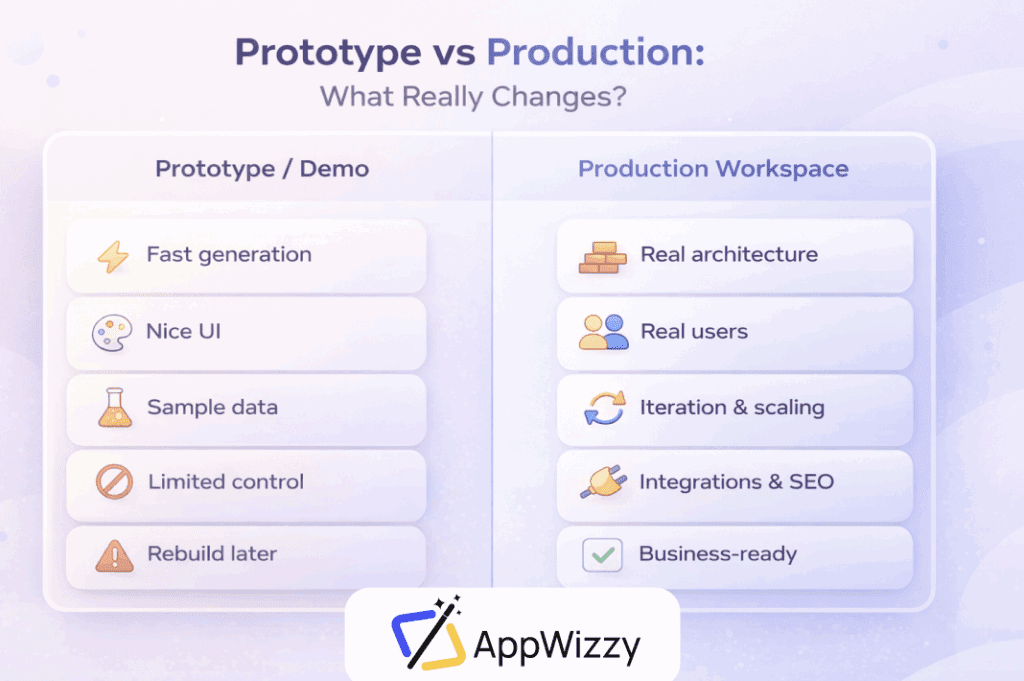
The core difference between AI builders today is not what they can generate, but what happens after the first version is created.
What Prototype-First AI Builders Are Designed For
Prototype-focused platforms are optimized for speed, visuals, and early validation.
Their main strengths:
- Extremely fast generation from a single prompt
- Polished-looking UI out of the box
- Instant previews that are easy to share with stakeholders
- Minimal setup or configuration
These tools are excellent for:
- Pitch decks and investor demos
- Validating an idea before committing resources
- Exploring multiple concepts quickly
- Non-technical users who want something tangible fast
However, prototypes come with hidden limitations:
- Design and structure are often generic
- Editing one feature may unexpectedly break another
- Limited control over data models, logic, or performance
- Weak or missing SEO, analytics, and compliance tooling
- Difficult or impossible handoff to developers
In short, prototype-first builders answer the question:
Can this idea exist?
They do not reliably answer:
Can this run a real business?
What Defines a Production-Ready AI Platform
Production-ready AI builders treat AI generation as the starting point, not the final result.
They are designed for:
- Ongoing development and iteration
- Real users, real data, and real traffic
- Collaboration between founders, marketers, and developers
- Long-term ownership and scalability
Key characteristics of production-ready platforms:
- Clear separation between frontend, backend, and data
- Stable editing workflows that don’t break existing functionality
- Built-in hosting, environments, and deployment controls
- SEO, performance optimization, and analytics support
- Ability to export, extend, or fully own the codebase
Instead of asking How fast can we generate something?, these platforms focus on:
How safely can this evolve?
Why This Difference Matters for Businesses
Many teams only realize the gap after they try to go live.
Common scenarios include:
- A prototype looks great, but can’t handle real users
- SEO settings are locked or insufficient
- Custom integrations aren’t possible
- Developers can’t realistically take over the project
- The tool becomes a bottleneck instead of an accelerator
At that point, teams are forced to rebuild, losing time, momentum, and often money.
Production-ready platforms reduce this risk by aligning AI speed with business reality. They acknowledge that while AI can accelerate creation, maintaining, scaling, and monetizing a product still requires structure.
The Key Question to Ask
When evaluating any AI website or web app builder in 2026, the most important question is not: How good does the first version look?
But rather: What happens after week two?
The rest of this article breaks down how leading AI builders handle this transition, from impressive demos to platforms that can actually support growth, customers, and long-term success.
Best AI Web App Builders in 2026
By 2026, the AI web app builder market will have clearly split into two categories: tools that generate impressive demos fast, and platforms that aim to support real, production-grade applications. Below is a curated list of the most relevant AI web app builders today, based on real usage, export options, and production workflows, starting with AppWizzy.
AppWizzy
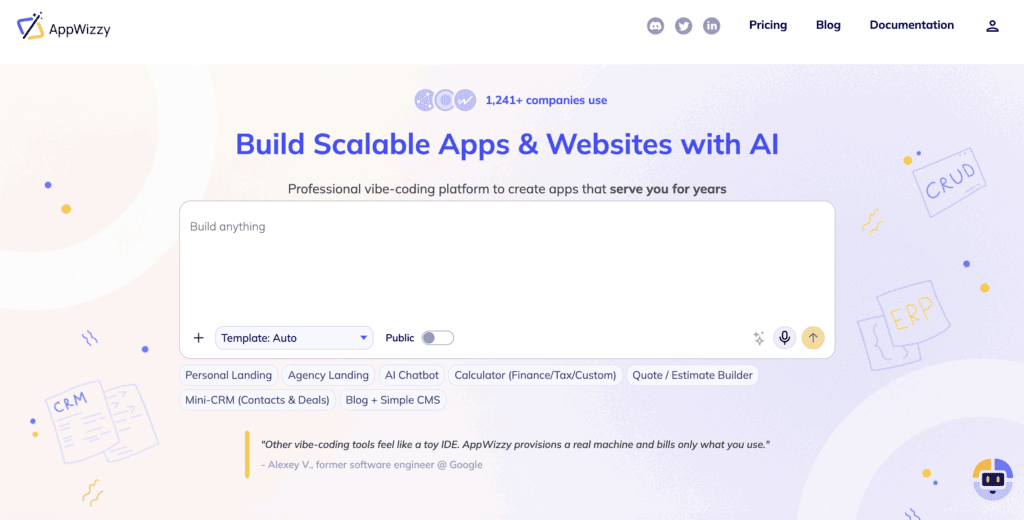
Best for: startups, small businesses, and teams that want AI speed without sacrificing long-term control
AppWizzy stands out in 2026 because it treats AI not as a shortcut, but as a development accelerator inside a real production workspace. Unlike many AI builders that stop at UI generation, AppWizzy focuses on full-stack web apps with clear structure, exportability, and ownership.
Key strengths:
- AI-driven generation of full web apps (frontend + backend)
- Real project workspace, not a disposable demo
- Native GitHub export and import (designed for developer handoff)
- Built for iteration, scaling, and real users, not just previews
AppWizzy is especially strong for founders who want to move fast and keep the option to grow, refactor, or fully own their codebase later.
Lovable
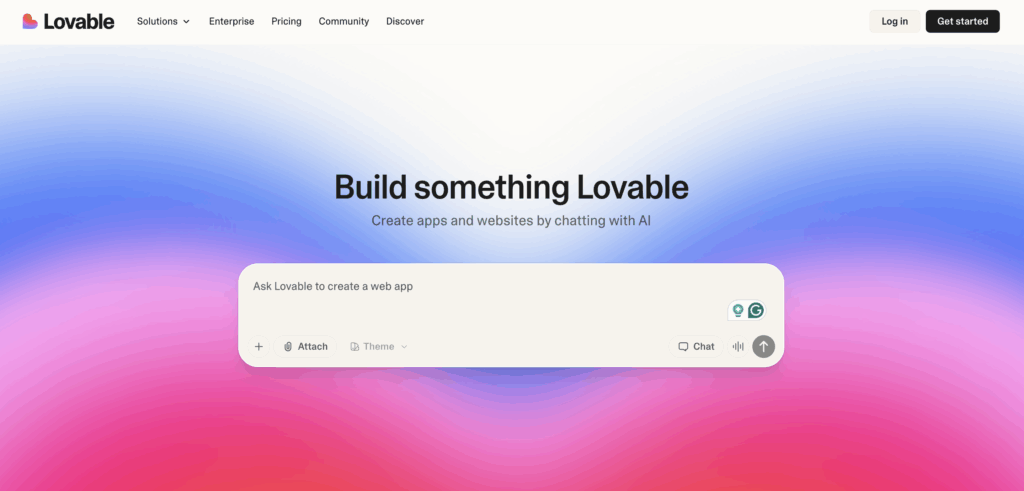
Best for: early-stage MVPs, non-technical founders, quick idea validation
Lovable is designed for speed. You describe what you want, and it generates a working web app with a clean UI almost instantly. It supports exporting projects directly to GitHub, which makes it more flexible than closed website builders.
Key strengths:
- Very fast prompt-to-app generation
- Clean, modern UI output
- GitHub export supported
Limitations:
- Best suited for early-stage prototypes
- Changes can become unstable as complexity grows
- Less control over deeper architecture decisions
Lovable is excellent for answering Should we build this?, but not always Can this run long-term?
Replit
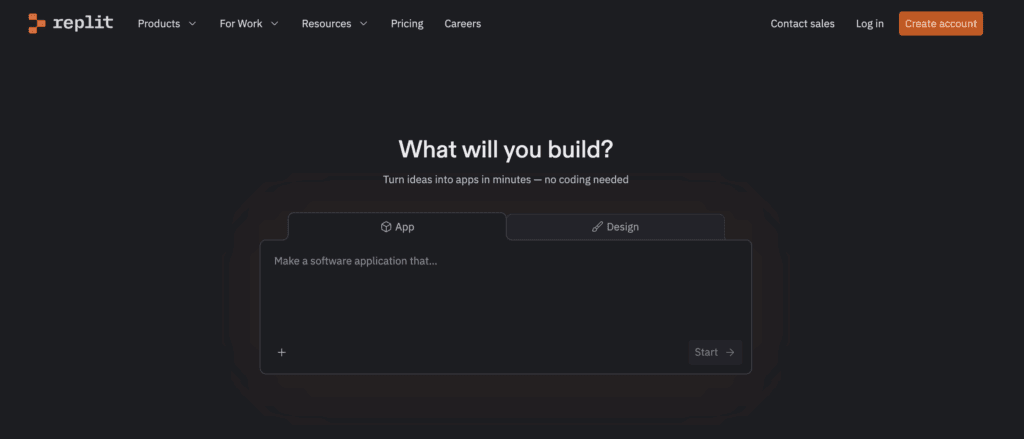
Best for: developers and technical founders who want AI inside a real IDE
Replit combines AI generation with a full cloud-based coding environment. Unlike no-code builders, Replit assumes you’re comfortable working with code, or want to become comfortable quickly.
Key strengths:
- Real coding environment with AI assistance
- Native GitHub integration
- Supports backend logic, databases, and deployments
Limitations:
- Steeper learning curve for non-technical users
- Less guided for business-focused workflows
Replit is less magic button and more AI-powered workshop.
Bolt.new
Best for: rapid experimentation, hackathons, proof-of-concepts
Bolt focuses on extreme speed. Projects can be opened directly in StackBlitz and synced with GitHub, making it popular among developers who want to explore ideas quickly.
Key strengths:
- Very fast generation
- Browser-based development environment
- GitHub sync via StackBlitz
Limitations:
- Optimized for greenfield projects only
- Output often needs restructuring for production
- Not designed for long-term maintenance workflows
Bolt shines in the first hours, not always in the first months.
Base44
Best for: internal tools, simple SaaS ideas, non-technical teams
Base44 focuses on turning prompts into functioning apps with authentication, data handling, and hosting included. It removes many technical steps but also abstracts away complexity.
Key strengths:
- Backend logic generated automatically
- Hosting and deployment included
- GitHub export/sync supported
Limitations:
- Customization is constrained by platform rules
- Less flexibility for advanced or unique architectures
Base44 works well when speed and simplicity matter more than deep control.
Vercel v0
Best for: frontend developers, design systems, component generation
Vercel v0 is not a full web app builder in the traditional sense. It focuses on generating UI components and layouts that can be exported to GitHub and integrated into existing projects.
Key strengths:
- High-quality UI generation
- Strong fit with modern frontend stacks
- Clean GitHub export
Limitations:
- No backend or app logic
- Requires an existing development workflow
v0 is best seen as a design accelerator, not a standalone builder.
TL;DR – Comparison Table
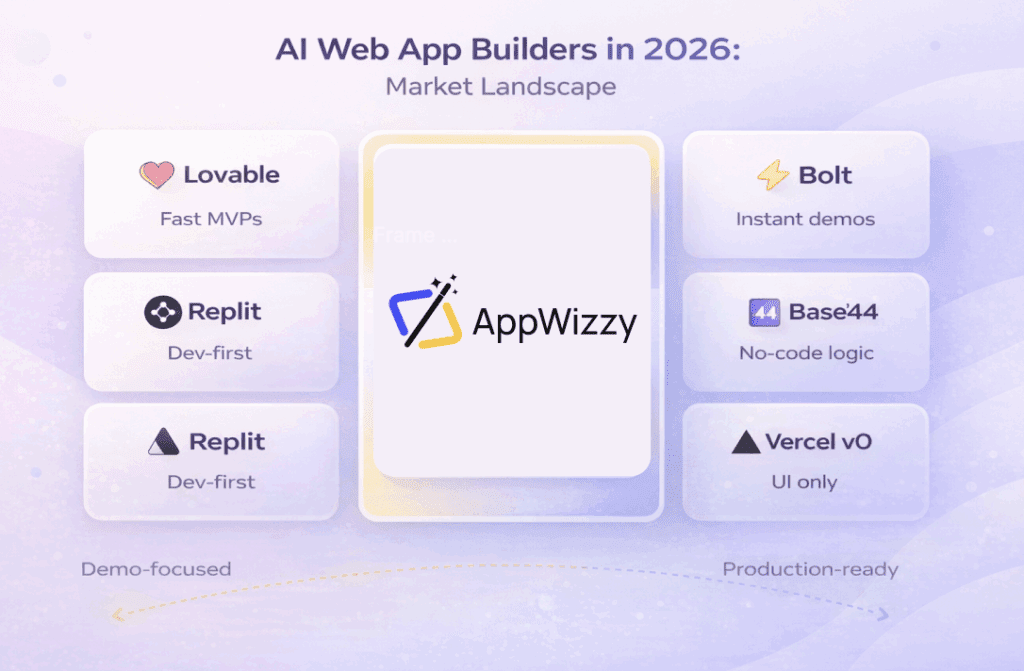
If you just want the short answer, this table summarizes how the most popular AI web app builders in 2026 compare across the dimensions that matter most for real businesses.
| Tool | Best For | Demo Speed | Production Readiness | GitHub Export | Backend & Logic | Long-Term Scalability |
| AppWizzy | Production web apps, startups | Fast | High | Yes (native) | Yes (full-stack) | High |
| Lovable | MVPs, idea validation | Very fast | Medium | Yes | Partial | Medium |
| Replit | Developers, technical teams | Medium | High | Yes | Yes | High |
| Bolt | Prototypes, experiments | Very fast | Medium | Yes (via StackBlitz) | Partial | Medium |
| Base44 | No-code apps, internal tools | Fast | Medium-High | Yes | Yes (abstracted) | Medium |
| Vercel v0 | UI & frontend generation | Fast | Low (UI-only) | Yes | No | Depends on external stack |
- If you need a real product, not just a demo → AppWizzy or Replit
- If you need to test ideas fast → Lovable or Bolt
- If you want no-code simplicity with built-in logic → Base44
- If you only need UI components → Vercel v0
Speed gets you started. Structure determines whether you survive past launch.
Serving Real Business Needs (Not Just Impressive Demos)
AI web app builders in 2026 are exceptionally good at creating something. The real challenge for businesses is making sure that something can handle customers, growth, and change.
A tool that works perfectly in a demo can quickly become a liability once real users, marketing campaigns, and operational requirements enter the picture. Serving real business needs requires much more than fast generation, it requires stability, control, and adaptability.
Below are the core areas where AI builders either support your business or quietly hold it back.
Reliability and Performance Under Real Use
Demos are tested with one user and sample data. Real businesses are not.
Production-ready platforms are designed to:
- Handle concurrent users without breaking
- Manage real databases, not mock data
- Maintain performance as traffic increases
- Avoid random regressions when making updates
Many demo-focused tools struggle here because their AI-generated structure lacks clear separation between logic, data, and UI. This often leads to fragile systems where small changes cause unexpected issues.
For a business, reliability isn’t a “nice to have”, it’s the minimum requirement.
Ownership, Control, and Vendor Risk
One of the most overlooked questions is: Who actually owns what you build?
Serving real business needs means:
- You can export your project to GitHub
- Developers can realistically take over the codebase
- You are not locked into a proprietary system
- You can migrate, refactor, or scale independently
Tools that don’t support clean export or structured handoff increase vendor lock-in. That might feel acceptable early on, but it becomes risky once the product gains traction.
Customization Beyond the First Version
Businesses rarely succeed with version one.
Real-world needs include:
- Custom integrations (payments, CRMs, analytics)
- SEO optimization beyond defaults
- Brand-specific design systems
- Regulatory and compliance requirements
AI builders that prioritize demos often generate rigid structures that are hard to adapt. Production-focused platforms expect change and make it possible to evolve the product without rebuilding from scratch.
Collaboration Between Non-Technical and Technical Teams
In real companies, products are not built by one person forever.
A business-ready platform must support:
- Founders and marketers working early
- Developers joining later without friction
- Clear versioning and change tracking
- Safe iteration without breaking live systems
This is where the difference between a “tool” and a “workspace” becomes clear. AI should enable collaboration, not isolate each role in a separate workflow.
SEO, Analytics, and Conversion Readiness
A beautiful AI-generated site that no one finds is not a business asset.
Serving real business needs means supporting:
- Search engine optimization controls
- Analytics and tracking
- Fast load times and mobile performance
- Conversion-focused layouts and forms
Many AI builders treat these as afterthoughts. Production-ready platforms treat them as first-class concerns.
The Business Reality Check
For businesses, the success of an AI web app builder is not measured by:
- How fast the first version appears, or
- How impressive the demo looks.
It’s measured by:
- How few rebuilds are needed?
- How smoothly does the product evolve?
- How confidently can the team grow on top of it?
The best AI builders in 2026 are not those that replace thinking, they are the ones that support real business decisions over time.
How to Choose the Right AI Web App Builder for Your Situation
With so many AI web app builders available in 2026, the biggest mistake teams make is choosing a tool based on how impressive the first result looks, instead of how well the tool fits their actual goals.
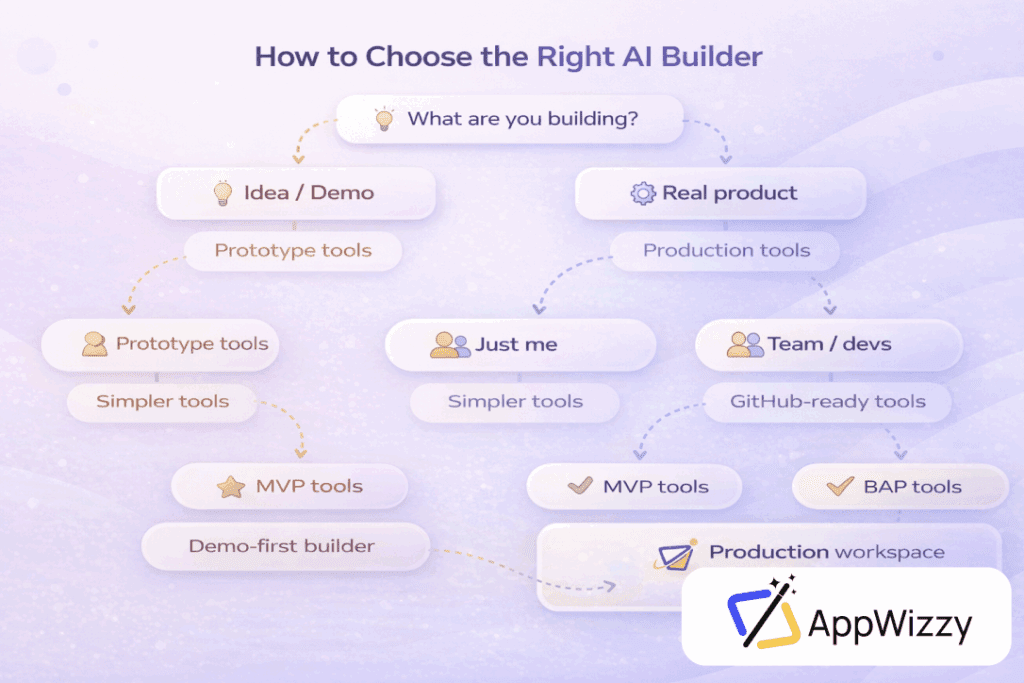
To make the right decision, start by being honest about what stage you’re in.
If you’re at the idea or validation stage, speed matters more than structure. You want to test assumptions, show something visual, and learn quickly. In this phase, demo-first builders can be extremely useful, as long as you treat the output as temporary.
If you’re preparing for a real launch, the priorities shift. You need stability, SEO, analytics, ownership, and the ability to iterate without fear of breaking everything. At this point, tools that support GitHub export, clear architecture, and developer collaboration stop being “nice to have” and become essential.
It’s also important to think about who will work on the product next. Will developers join later? Will marketers need to update content? Will integrations be required? If the answer to any of these is “yes”, choose a platform that supports handoff and long-term workflows.
Finally, remember that AI is not replacing product decisions, it’s accelerating them. The best builders don’t remove responsibility; they reduce friction while preserving control.
Choosing wisely upfront doesn’t just save time. It protects momentum, and that’s often the difference between a project that launches and one that quietly stalls.
Summing Up
AI web app builders in 2026 have reached an impressive level of speed and accessibility. What once took weeks of planning and development can now happen in minutes. But as this article has shown, speed alone is not the goal. The real risk is mistaking a polished prototype for a foundation you can actually build a business on.
The most important takeaway is simple: the value of an AI builder is revealed after the first version is created. When real users arrive, when SEO matters, when integrations are required, and when developers need to step in, the differences between tools become impossible to ignore. Some platforms quietly turn into bottlenecks, while others continue to accelerate progress.
This is where Appwizzy stands out, not because it promises magic, but because it treats AI as part of a real production workflow rather than a one-click demo generator.
If you’re testing ideas, demo-focused tools can absolutely help you move fast. But if you’re building something meant to last, something that can grow, adapt, and survive real business pressure, your choice of platform matters more than ever. The best AI web app builders in 2026 don’t just help you launch; they help you avoid rebuilding.
Choose the tool that matches not just where you are today, but where you want your product to be six months from now. That decision will save you more time, money, and frustration than any AI shortcut ever could.