TL;DR
- A 24-hour full-stack build targets an MVP: one core feature, one working user flow, and a live deployed URL.
- Build a “vertical slice” end-to-end (UI → backend → database → UI) to validate fast, not to perfect.
- Avoid time killers: overengineering, feature creep, late integration, and waiting until the end to deploy.
- AppWizzy can generate frontend, backend, database, auth, and hosting from a plain-English prompt, then iterate via chat.
Fact Box
- “Full-stack in 24 hours” means a functional MVP that connects frontend, backend, and database end-to-end.
- The article defines “done” as deployable: if it’s not hosted online and usable, it doesn’t count.
- A 24-hour build intentionally excludes scalability optimization, advanced security layers, edge-case handling, and extensive test suites.
- AppWizzy’s flow: describe the app → it generates data model, backend+frontend, and provisions a VM environment.
- In the example, AppWizzy produces a task app with signup/login, UI, and a connected backend+database, then updates via chat.
What if you could go from idea to a working full-stack application in less than 24 hours, without burning out your team or cutting corners on quality? This guide will show you exactly how.
If you’ve landed here, you’re probably asking yourself a few key questions:
- Is it actually possible to build a full-stack app in a single day?
- What tools and frameworks make this realistic for small teams or startups?
- How do I avoid technical debt when moving this fast?
- Can no-code or low-code platforms really compete with traditional development?
As software pioneer Alan Kay once said, “The best way to predict the future is to invent it”. And in today’s startup landscape, speed is often the difference between relevance and irrelevance.
The pressure to ship faster is not just anecdotal. It’s backed by research. Studies from organizations like McKinsey and the Standish Group consistently show that faster iteration cycles significantly improve product-market fit and reduce failure rates. Yet, many small and medium-sized businesses (SMBs) struggle to balance speed with quality. Traditional development cycles can take weeks or months, creating bottlenecks that delay feedback, increase costs, and risk missing market opportunities.
By reading this article, you’ll understand how to build a full-stack application in under 24 hours, realistically. You’ll learn the mindset, tools, architecture, and workflow needed to move fast without breaking things. Most importantly, you’ll get a step-by-step guide to doing it using Appwizzy, so you can turn ideas into working products today, not someday.
Why Building in 24 Hours Is No Longer Crazy
Not long ago, the idea of building a full-stack application in under 24 hours sounded unrealistic, something reserved for hackathons or sleepless weekends fueled by caffeine and shortcuts. Today, it’s a practical strategy used by startups and SMBs to validate ideas, reduce risk, and move faster than competitors.
What changed isn’t just technology. It’s the entire development ecosystem.
First, modern frameworks have eliminated much of the repetitive work that used to slow teams down. Tasks like authentication, routing, and state management, once complex and time-consuming, are now handled through pre-built modules and integrations. Developers no longer need to start from scratch; they assemble instead of building.
Second, cloud infrastructure has become instant and invisible. Setting up servers, configuring environments, and managing deployments used to take days or weeks. Now, platforms provide one-click deployment, automatic scaling, and built-in monitoring. This removes one of the biggest historical bottlenecks in development.
Third, and most transformative, is the rise of low-code and no-code platforms like Appwizzy. These tools abstract away both frontend and backend complexity, allowing teams to focus on business logic and user experience instead of wiring everything manually. For SMBs and startups with limited resources, this dramatically lowers the barrier to entry.
Equally important is a shift in how products are built and evaluated. The goal is no longer to launch a perfect product. It’s to test a hypothesis as quickly as possible. A 24-hour build isn’t about cutting corners; it’s about identifying what truly matters and ignoring everything else until it’s proven necessary.
In this context, speed becomes a strategic advantage. The faster you can turn an idea into something real, the faster you can gather feedback, iterate, and improve. Instead of spending months building something users may not want, you spend a day building something you can learn from immediately.
That’s why building in 24 hours is no longer crazy. It’s often the smartest move you can make.
What “Full-Stack in 24 Hours” Actually Means
Before diving into execution, it’s critical to reset expectations. “Building a full-stack app in 24 hours” doesn’t mean delivering a polished, enterprise-ready product. It means creating a functional, end-to-end application that solves a specific problem and can be used, tested, and validated by real users.
At its core, a full-stack app includes three essential layers:
- Frontend – the user interface people interact with
- Backend – the logic that processes requests and handles workflows
- Database – where your application stores and retrieves data
A 24-hour build means all three layers are connected and working together, not perfectly, but reliably enough to demonstrate value.
What You Are Building
In this timeframe, your goal is to produce a Minimum Viable Product (MVP). That means:
- A clear, single-use case (one core feature)
- A working user flow (e.g., sign up → perform action → see result)
- Basic data storage and retrieval
- A deployed app accessible via a live URL
For example, instead of building a full project management platform, you might build:
- A simple task creator with status tracking
- A lightweight dashboard showing tasks
- A login system to separate users
That’s it. No advanced analytics, no integrations, no scalability concerns, yet.
What You’re Not Building
Equally important is understanding what’s intentionally left out:
- Scalability optimization (no need for microservices or load balancing)
- Advanced security layers beyond basic authentication
- Complex edge-case handling
- Highly refined UI/UX design
- Extensive automated testing suites
Trying to include these will almost certainly push you past the 24-hour mark.
The Real Objective: Validation, Not Perfection
A 24-hour full-stack build is best understood as a validation tool.
You’re answering questions like:
- Does this idea actually solve a real problem?
- Will users engage with this feature?
- Is the workflow intuitive?
Instead of investing weeks or months upfront, you’re compressing the feedback loop into a single day.
Think in Terms of “Vertical Slice”
A helpful way to approach this is by building a vertical slice of your product. Rather than partially building many features, you fully build one complete flow across all layers:
- A user takes an action in the UI
- The backend processes it
- The database stores it
- The result is displayed back to the user
Even if everything else is missing, this one flow proves your concept works.
Done Means Deployable
Another key principle: if it’s not deployed, it’s not done. A local app on your machine doesn’t count. Within 24 hours, your app should:
- Be hosted online
- Be accessible via a public or shareable link
- Allow real users to interact with it
This is what turns your build from a prototype into a real experiment.
In short, “full-stack in 24 hours” means building just enough of the right things to make your idea real, testable, and valuable. It’s not about doing everything, it’s about doing the essential things extremely well and extremely fast.
Common Mistakes to Avoid
Building a full-stack app in 24 hours is less about technical ability and more about discipline. Most teams that fail don’t run out of skill. They run out of time due to avoidable decisions. Understanding these common mistakes can be the difference between launching something usable and ending the day with half-finished code.
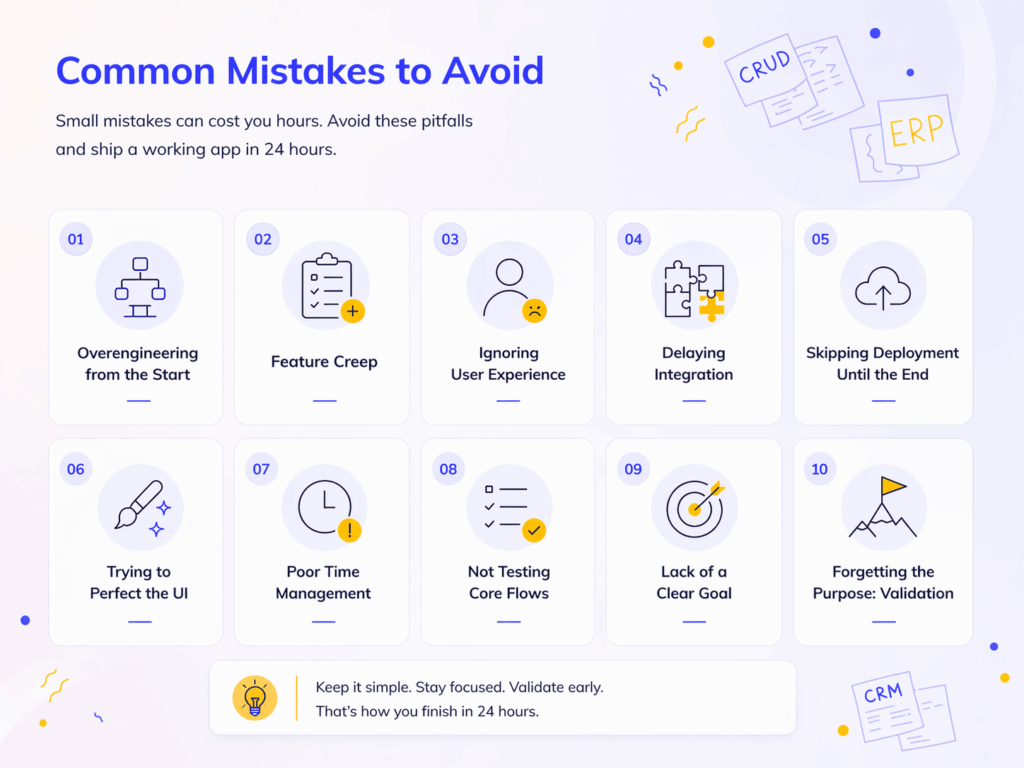
Overengineering from the Start
One of the most common pitfalls is trying to design a system that is ready for scale before it even has users. Teams often begin thinking about microservices, complex database schemas, or highly abstracted architectures. While these decisions may be valuable later, they are counterproductive in a 24-hour build. The more complexity you introduce early on, the slower every subsequent step becomes. In this context, simplicity is not a compromise. It is a strategy. A straightforward solution that works today is far more valuable than an elegant system that never gets completed.
Feature Creep
What begins as a simple idea can quickly spiral into something unmanageable. Adding “just one more feature” feels harmless in the moment, but each addition compounds the workload. Over time, the original scope becomes diluted, and the team loses sight of the core objective. The real danger of feature creep is not just the extra work. It’s the shift in focus. Instead of building something functional, you end up building something incomplete. Maintaining strict discipline around the scope is essential if you want to finish within 24 hours.
Ignoring User Experience
Speed often leads teams to deprioritize usability, but this is a mistake. Even a minimal product must be intuitive enough for someone to use without guidance. If users cannot quickly understand what to do, the app fails its purpose regardless of how quickly it was built. Poor navigation, unclear actions, or lack of feedback can make an otherwise functional app feel broken. A clean, simple interface that clearly guides the user is far more important than visual polish.
Delaying Integration
Another frequent issue is treating frontend and backend development as separate phases for too long. Everything may appear to work independently, but problems often surface when the two are finally connected. At that point, fixing inconsistencies can take far longer than expected. Early integration helps expose issues sooner, when they are easier to resolve. It also ensures that the application evolves as a cohesive system rather than disconnected parts.
Skipping Deployment Until the End
Many teams postpone deployment until the final hours, assuming it will be a quick step. In reality, deployment often introduces unexpected challenges, from configuration errors to environment mismatches. When this happens late in the process, there is little time left to troubleshoot. Deploying early, even with a rough version, helps validate your setup and reduces the risk of last-minute surprises.
Trying to Perfect the UI
Design perfection can easily consume hours without significantly improving the core value of the product. Adjusting spacing, refining colors, or adding animations may feel productive, but these efforts rarely impact whether the app actually works. In a 24-hour build, functionality must take priority over aesthetics. A simple, clean interface is enough to support validation. Visual refinement can always come later, once the idea has proven its worth.
Poor Time Management
Without a clear structure, it is easy to spend too much time on one part of the application while neglecting others. Teams often get stuck refining a single component, only to realize they have little time left for integration or testing. This imbalance leads to unfinished or unstable products. Dividing the available time into clear phases and sticking to them creates a sense of urgency and helps maintain momentum throughout the build.
Not Testing Core Flows
Skipping testing may seem like a way to save time, but it often leads to a non-functional product at the end. The key is not to test everything, but to focus on what matters most. If the main user journey is broken, the app cannot serve its purpose. Ensuring that the primary flow works from start to finish is far more important than handling every edge case.
Lack of a Clear Goal
A vague objective makes it difficult to make decisions quickly. When the goal is not clearly defined, teams tend to second-guess priorities, change direction, and add unnecessary features. This lack of clarity slows progress and creates confusion. A specific, measurable outcome provides focus and makes it easier to determine what should and should not be built.
Forgetting the Purpose: Validation
Perhaps the most serious mistake is treating the 24-hour build as an end in itself rather than a means to an end. The goal is not just to build something, it is to learn something. Without a plan for gathering feedback or evaluating success, even a completed app has limited value. Keeping validation at the center of the process ensures that every decision supports a larger objective.
Avoiding these mistakes doesn’t guarantee perfection, but it dramatically increases your chances of finishing with a working, meaningful product. In a 24-hour build, success comes from focus, restraint, and a clear understanding of what truly matters.
How to Build a Full-Stack App with AppWizzy (Step-by-Step)
To build a full-stack app in under 24 hours, you need clarity not just on what to do, but exactly where to click and how to move through the tool. Below is a practical, click-by-click guideline using a simple example: a task management app where users can sign up and create tasks.
Step 1: Describe Your App
When you open AppWizzy, you’ll see a large input field labeled “Build anything.” This is where everything starts. Click into the field and describe your app in plain English.
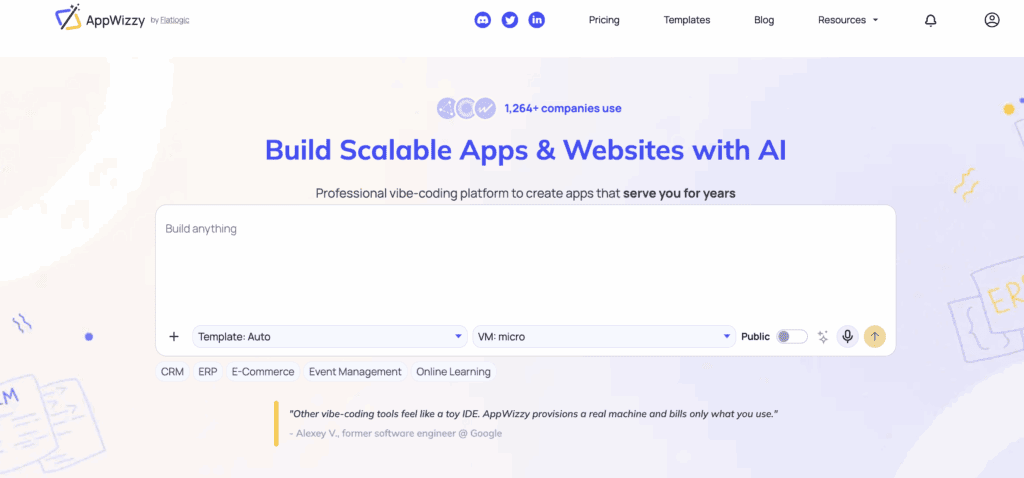
For example: “Build a task management app where users can register, create tasks, assign status, and mark tasks as completed”.
Before submitting, you can optionally adjust a few settings below the input:
- Template: set to Auto by default (AppWizzy will choose for you)
- VM: select environment size (e.g., micro)
- Public: toggle if the app should be publicly accessible
You don’t have to change anything here, defaults are usually fine. Click the arrow (→) button to start.
Use Other Entry Options (Optional)
The same input field supports more than just prompts.
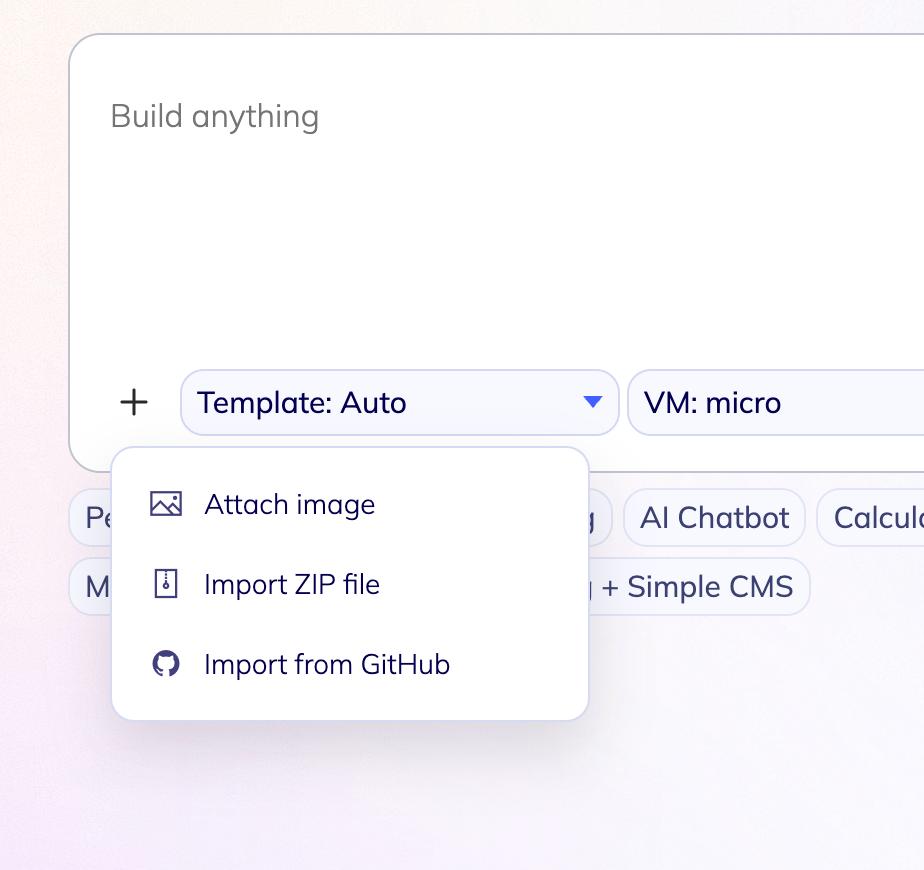
You can also:
- Upload a Git repository or archive to continue an existing project
- Attach a PDF, screenshot, or spec as a reference
- Manually choose a template instead of Auto
All of these options are available in the same starting step, you don’t need a different workflow.
Step 2: AppWizzy Creates the App Automatically
After submitting your request, AppWizzy immediately starts building your application.
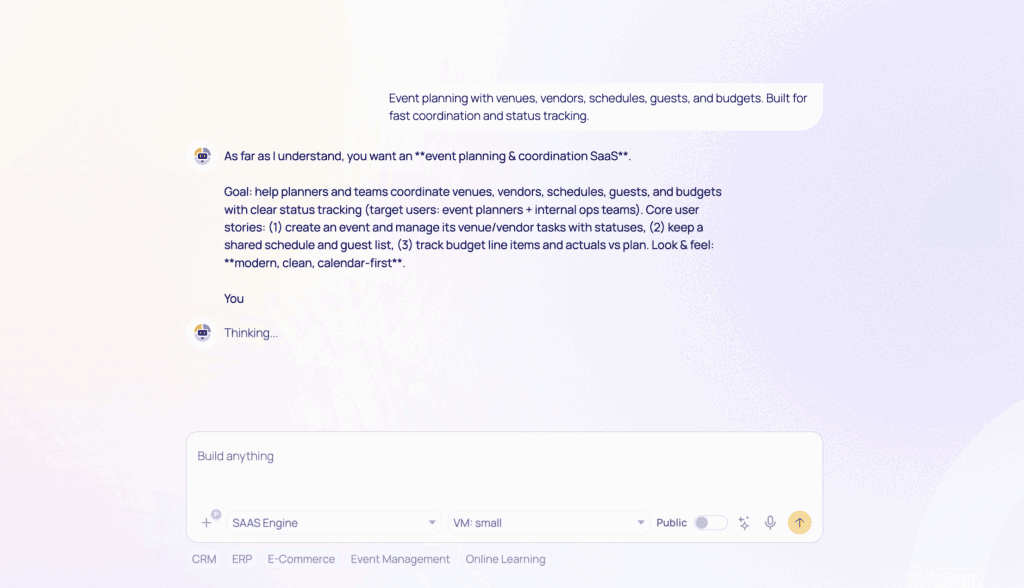
It will:
- Choose a suitable template (if left on Auto)
- generate the data model
- create backend and frontend
- provision a real environment (VM)
There’s no separate configuration or “generate” step. Everything happens in one flow. Within a short time, your app is ready.
Step 3: Open and Test Your App
Once the process completes, open your app.
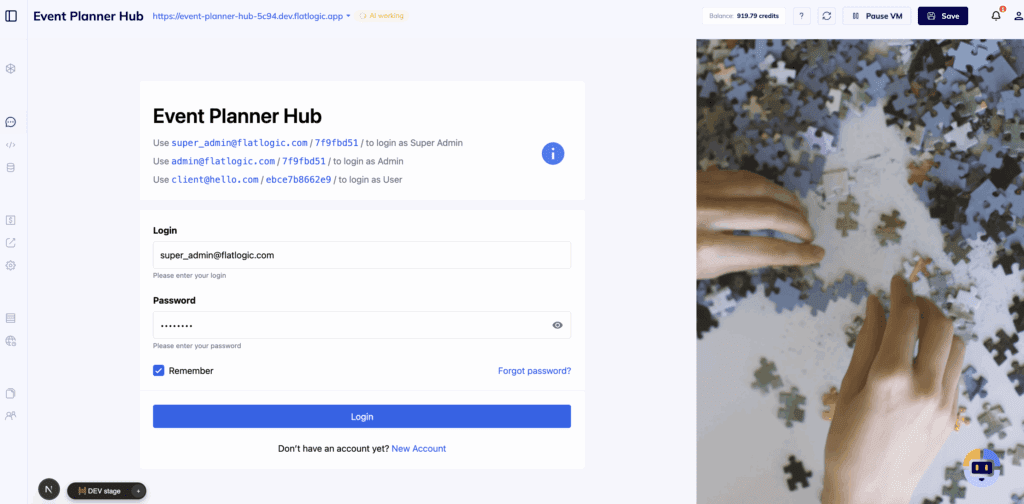
You’ll get a working system with:
- Authentication (signup/login)
- UI (dashboard, lists, forms)
- Backend and database already connected
Create a test account and try basic actions, add tasks, change status, and edit entries. At this point, you already have a functional full-stack app.
Step 4: Improve It Using Chat
Now you move into iteration. Use the chat to refine and expand your app. Just describe what you want to change.
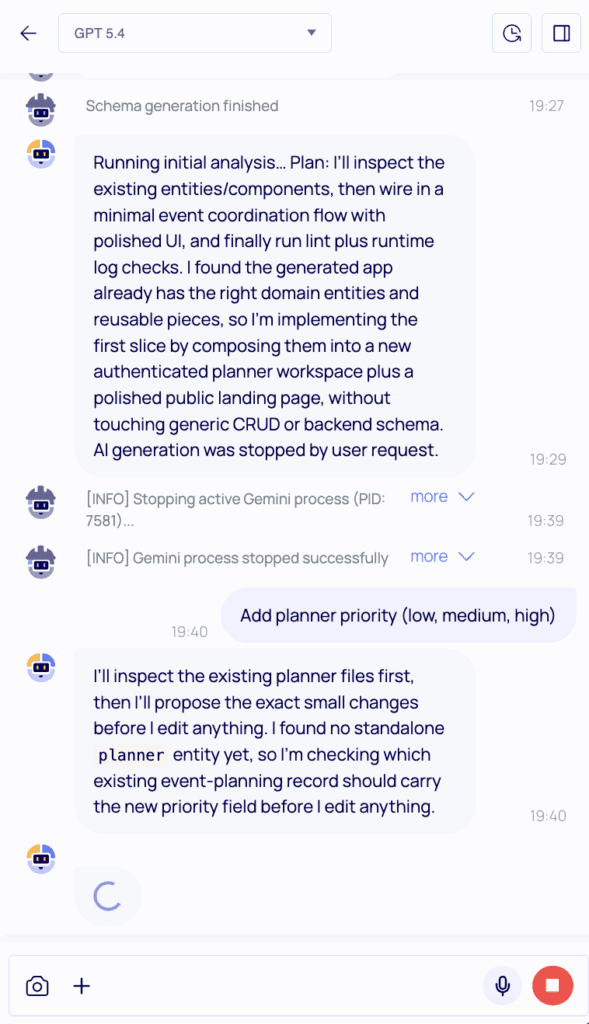
For example:
- “Add task priority (low, medium, high)”
- “Add admin role with full access”
- “Show tasks in kanban view”
Submit the request, and AppWizzy will apply updates across the system:
- schema
- backend logic
- UI
Refresh your app to see the changes.
Final Result
In a few steps, you get a working full-stack application with:
- database
- backend API
- frontend UI
- authentication
- real hosting environment
From there, you keep building by iterating, not by restarting.
Conclusion
Building a full-stack app in under 24 hours isn’t a gimmick. It’s a shift in how modern products are created, tested, and improved. For SMBs and startups, the real advantage isn’t just speed, but the ability to turn ideas into something tangible before time, budget, and assumptions get in the way.
What makes this approach work is not cutting corners, but cutting everything unnecessary. By focusing on a single core feature, building a complete vertical slice, and getting your app in front of real users as quickly as possible, you replace guesswork with data. That’s where better decisions and better products come from.
Tools like Appwizzy make this process even more accessible by removing technical overhead and letting you move from idea to execution in hours, not weeks. But the tool alone isn’t the solution. The real impact comes from adopting the right mindset: prioritize validation over perfection, progress over polish, and learning over assumptions.
At the end of the day, a 24-hour app is not your final product. It’s your starting point. It’s the fastest way to answer the only question that really matters: Does this idea deserve to exist?
And once you have that answer, you’re no longer guessing, you’re building with confidence.