


TL;DR
- Replit Agent uses chat-to-app: describe an app in natural language and AI generates code, setup, and deployment quickly.
- AppWizzy uses template-to-production: start from a production-ready template, then use AI to customize features and schema.
- Chat-to-app excels at fast prototyping and idea validation; template-to-production favors predictable architecture and scaling.
- AppWizzy emphasizes full code ownership and deployable infra; Replit Agent keeps projects primarily in the Replit ecosystem.
- Many teams will use a hybrid flow in 2026: chat tools for ideation, templates for production systems.
Fact Box
- GitHub research cited says AI coding assistants can help developers complete tasks up to 55% faster.
- McKinsey research cited says the global shortage of software engineers could reach millions by the end of the decade.
- AppWizzy generates production-ready web apps with backend, database, deployable infrastructure, and full codebase access.
- Replit Agent generates apps from natural-language prompts and sets up the environment, dependencies, and deployment in Replit.
- The article frames Replit Agent as best for prototyping, and AppWizzy as better for scalable MVPs and long-term systems.
What if building a working application could take minutes instead of months, and the only question left is which AI approach actually gets you there faster?
When we start looking for AI-powered tools to build applications, we often ask ourselves a few key questions:
- Can AI really turn an idea into a working product without a full engineering team?
- Which approach is faster: generating an app through chat or starting from a ready-made template?
- How much control will I have over the final product and its codebase?
- Will the platform scale if my MVP becomes a real product?
As computer scientist Alan Kay famously said, “The best way to predict the future is to invent it”. Today, AI-powered development platforms are doing exactly that, changing how we design, build, and launch digital products.
We are also facing a growing challenge in software development: the demand for digital products is rising much faster than the supply of developers. According to research from McKinsey, the global shortage of software engineers could reach millions by the end of the decade, pushing companies to look for new ways to build software faster. At the same time, studies on AI-assisted coding tools show significant productivity gains. For example, research from GitHub found that developers using AI coding assistants can complete tasks up to 55% faster. This gap between demand and available engineering talent is one of the main reasons why AI-powered development platforms are rapidly gaining popularity.
In this article, I explore two different approaches to AI-powered app development: Replit Agent’s chat-to-app model and AppWizzy‘s template-to-production workflow. By the end, we’ll understand how these platforms compare in terms of user experience, AI integration, development speed, customization, scalability, pricing, and collaboration, helping us decide which approach better fits our product goals and development strategy.
What Is Chat-to-App Development?
Chat-to-app development is an emerging approach to software creation where applications are built primarily through natural language interaction with AI. Instead of manually writing code or assembling components step by step, we simply describe what we want to build, and an AI system generates the necessary application structure, logic, and interface.
In practice, the workflow looks very similar to having a conversation with an AI assistant. We explain the idea for the product, such as a dashboard, a marketplace, or an internal tool, and the AI interprets that request and converts it into code. It can generate the frontend, backend, database structure, and even deployment configuration based on the description we provide.
This approach significantly lowers the barrier to building software. Product managers, founders, and non-technical teams can move from concept to working prototype without deep programming knowledge. The AI essentially acts as a virtual development partner, translating ideas into functioning applications.
Another defining characteristic of chat-to-app platforms is iterative conversation. Once the initial application is generated, we continue refining it through prompts. For example, we might ask the AI to add authentication, modify the UI, integrate a payment system, or fix bugs. Each instruction results in new code changes, allowing the product to evolve quickly through dialogue rather than manual implementation.
Because of this workflow, chat-to-app development is particularly effective for:
- Rapid prototyping
- Early-stage MVP development
- Experimenting with product ideas
- Building internal tools
However, this model can also introduce certain limitations. Since the architecture is generated dynamically through prompts, the resulting code structure may vary depending on how the AI interprets the request. This means that while the process is extremely fast, teams sometimes need to review and reorganize parts of the generated code when preparing the product for long-term scaling.
Overall, chat-to-app development is a conversation-driven approach to building software, where natural language replaces much of the traditional coding process. Platforms like Replit Agent demonstrate how AI can transform product ideas into working applications within minutes.
What Is Template-to-Production Development?
Template-to-production development takes a slightly different approach to AI-assisted software creation. Instead of generating an application entirely from scratch through conversation, the process begins with a pre-built template that already includes a working product structure.
These templates typically provide the core building blocks of modern applications, such as authentication, database models, admin panels, APIs, and user interfaces. Rather than asking AI to design everything from scratch, we start with a proven architecture and then customize it with AI assistance.
The workflow usually follows several steps. First, we describe the product idea and select a template that closely matches the type of application we want to build, such as an admin dashboard, SaaS platform, marketplace, or CRM. The platform then generates the project using that template as a foundation.
From there, AI tools help modify and extend the application. We can ask the system to generate new pages, add features, adjust the database schema, or integrate external services. The template provides a stable starting point, while AI accelerates the customization process.
One of the key advantages of this model is that the application structure is predictable and production-ready from the start. Because templates are built on established technology stacks and development patterns, the resulting project is often easier to maintain, scale, and extend compared to purely generated code.
Template-to-production development is especially valuable for:
- Startups building their first MVP
- Companies launching SaaS products
- Teams that need production-ready architecture quickly
- Businesses that want to maintain full ownership of their codebase
Another important aspect is code transparency and control. Since the project is built on a real template and infrastructure, developers can review, edit, and manage the code just like any traditional software project. AI acts as an accelerator rather than the sole creator of the application.
In many ways, template-to-production development blends the speed of AI generation with the reliability of established software frameworks. Instead of starting with a blank page, teams begin with a working foundation and use AI to transform it into a fully customized product ready for real users.
Replit Agent vs AppWizzy: Chat-to-App vs Template-to-Production
AI-powered development tools are evolving quickly, and by 2026, two major approaches have emerged: Chat-to-App and Template-to-Production. Both promise to reduce the time needed to build web applications dramatically, but they solve the problem in very different ways.
In Chat-to-App development, the process begins with a simple prompt. We describe the application we want, and the AI generates the project structure, code, database, and interface directly from that description. These systems rely heavily on natural-language interaction, turning conversations into working software.
In Template-to-Production development, the workflow starts from a different place. Instead of generating everything from scratch, we begin with a ready-made application template that already contains core functionality and architecture. AI then customizes and extends this foundation, helping us transform the template into a fully tailored product.
Both models aim to accelerate development and reduce engineering effort. However, the difference between starting from a blank prompt versus starting from a structured template has a major impact on speed, reliability, scalability, and developer control.
What Is AppWizzy?
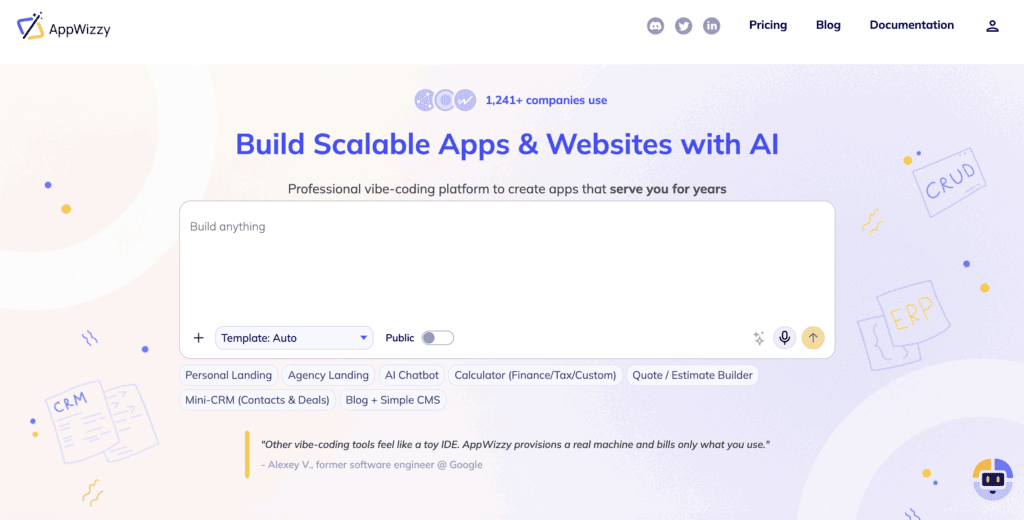
AppWizzy is an AI-powered platform designed to generate production-ready web applications with real backend infrastructure, databases, and deployable code. The platform focuses on helping teams quickly build SaaS platforms, internal tools, CRM systems, admin panels, and other business applications.
The key idea behind AppWizzy is template-to-production development. When creating a project, users select a pre-built application template that serves as the foundation for the system. These templates may include dashboards, CRUD functionality, authentication systems, and data models that are commonly required in modern applications.
Once the template is selected, AI assists with customizing and expanding the application. It can generate new entities, modify the database schema, add integrations, and adapt the interface to match the product requirements.
One of the defining characteristics of AppWizzy is that it generates real production infrastructure rather than just prototypes. Each project runs on a dedicated cloud environment and provides full access to the generated codebase. This allows developers to download, modify, and scale the application using standard development tools without vendor lock-in.
Because of this approach, AppWizzy is particularly suited for:
- Startups building production MVPs
- Companies launching SaaS platforms
- Teams that need scalable internal tools
- Developers who want full control of their codebase
Instead of focusing purely on AI generation, the platform combines AI assistance with proven software architecture, allowing teams to move from concept to production faster.
When to Choose AppWizzy
AppWizzy becomes particularly valuable when the goal shifts from experimentation to building a production-ready product. Instead of generating an application from scratch through prompts, the platform provides structured templates that already include common elements of modern software systems.
This approach significantly reduces the amount of time needed to create a stable and scalable architecture. Authentication, database models, APIs, dashboards, and admin interfaces are already included in the template, allowing teams to focus on building the unique features of their product.
AppWizzy is especially useful when we need to:
- Build SaaS MVPs ready for real users
- Create internal business systems
- Launch data dashboards or CRM tools
- Develop scalable web platforms
- Maintain full ownership of the codebase
Another important advantage of template-to-production development is predictability. Because the application is built on proven architecture patterns, it becomes easier for developers to maintain, extend, and scale the system over time.
For startups moving beyond the prototype stage, this structure can make a major difference. Instead of rebuilding an early prototype from scratch, teams can start with a production-ready foundation and grow the product from there.
What Is Replit Agent?
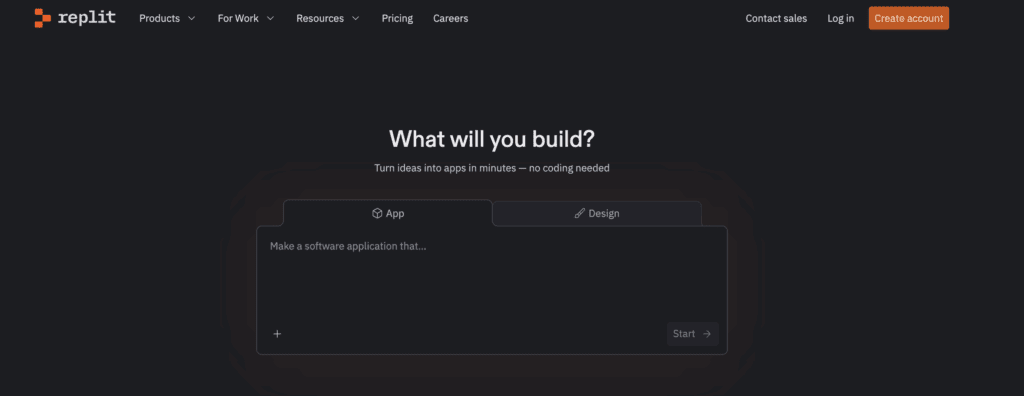
Replit Agent is an AI-powered coding system built into the Replit development platform that can create applications directly from natural-language prompts. Users simply describe the app they want to build, and the agent automatically generates the code, sets up the development environment, installs dependencies, and deploys the application.
The tool represents the chat-to-app development model. Instead of choosing templates or manually assembling components, users interact with the AI through a conversation. The system interprets the request and produces a working application, often including databases, APIs, and user interfaces generated from a single prompt.
Replit Agent acts almost like an autonomous developer inside the development environment. It can plan tasks, modify multiple files, test code, and continuously improve the application while it is being built.
This approach makes software creation accessible to a much wider audience. Even users with minimal programming experience can build prototypes or functional tools simply by describing their ideas.
Replit Agent is especially useful for:
- Rapid prototyping
- Experimenting with product ideas
- Building internal tools quickly
- Learning programming concepts
The platform’s goal is to remove the traditional friction of software development by replacing much of the coding process with natural-language interaction.
When to Choose Replit Agent
Replit Agent is particularly useful when the goal is speed, experimentation, and rapid idea validation. The platform is designed around conversational development, making it easy to move from concept to working prototype without worrying about infrastructure, architecture, or project setup.
For startups and product teams, this can be extremely valuable during the early stages of product discovery. Instead of spending weeks setting up a development environment or writing initial code, we can generate a working prototype in minutes simply by describing the idea.
Replit Agent is often the best choice when we need to:
- Test product ideas quickly
- Create prototypes for investor demos
- Build simple internal tools
- Experiment with UI concepts or workflows
- Validate market demand before building a full product
Another advantage of chat-to-app development is accessibility. Teams without deep engineering resources can still explore product ideas and iterate quickly. The conversational interface removes much of the complexity traditionally associated with web development.
However, as the project grows and the product architecture becomes more complex, teams may need to spend additional time organizing the generated code or adapting it to long-term production needs. This is why many teams use chat-to-app tools primarily during the early innovation stage of development.
AppWizzy vs Replit Agent: Key Comparison
To better understand the differences between Chat-to-App and Template-to-Production development, it helps to compare the capabilities of the two platforms side by side. The table below highlights the main differences between AppWizzy and Replit Agent across key factors important for startups, product managers, and SMBs.
| Feature | AppWizzy | Replit Agent |
| Development approach | Template-to-Production development | Chat-to-App development |
| How apps are created | Start with a production-ready template and customize it with AI | Describe the app in natural language and AI generates it from scratch |
| AI role | AI assists with customization, schema generation, and feature development | AI acts as an autonomous coding agent that writes and updates the code |
| Infrastructure | Generates full-stack apps with real backend, database, and deployable infrastructure | Builds apps inside the Replit cloud development environment |
| Code ownership | Full access and ownership of the generated codebase | Code lives primarily inside the Replit ecosystem |
| Architecture | Structured architecture based on proven templates | Architecture generated dynamically from prompts |
| Best use cases | SaaS MVPs, internal tools, CRM systems, production apps | Prototypes, experiments, early-stage product ideas |
| Customization | High flexibility with editable code and scalable templates | Customization mainly through prompts and code edits |
| Deployment | Production-ready deployments with customizable infrastructure | One-click deployment within the Replit platform |
| Learning curve | Slightly higher because templates and architecture must be selected | Very beginner-friendly due to conversational workflow |
| Speed of prototyping | Fast MVP generation with structured templates | Extremely fast idea-to-prototype through prompts |
| Scaling potential | Designed for long-term product development | Often used for early prototypes or small projects |
Replit Agent focuses on conversational app generation, where users describe an idea and the AI builds the application automatically. The system can generate full-stack applications, set up databases, and deploy the project directly from natural-language prompts.
AppWizzy, in contrast, emphasizes production-ready application generation using structured templates and full code ownership, allowing developers to modify and scale their applications without vendor lock-in.
In practice, both tools solve the same problem, accelerating web development with AI, but they target different stages of the product lifecycle. Replit Agent excels at rapid experimentation and ideation, while AppWizzy focuses on building structured applications that can evolve into long-term production systems.
What to Choose in 2026 for Web Development: Chat-to-App vs Template-to-Production
As AI development platforms mature, the choice between Chat-to-App and Template-to-Production increasingly depends on what stage of product development we are in.
If the goal is rapid experimentation, chat-to-app tools like Replit Agent can be extremely effective. They allow founders, product managers, and designers to quickly test ideas and generate prototypes without worrying about architecture or infrastructure. For early-stage ideation and experimentation, the speed of conversational development can be a major advantage.
However, when the goal shifts from experimentation to building a real product, template-to-production platforms like AppWizzy often provide a more stable foundation. Because applications start with established templates and full-stack architecture, the resulting systems are typically easier to maintain, customize, and scale.
In practice, the two approaches often complement each other:
- Chat-to-App is ideal for ideation and quick prototypes.
- Template-to-Production is better suited for building scalable products and long-term systems.
By 2026, many teams will be adopting a hybrid workflow: using chat-driven tools to explore product ideas and then moving to template-based platforms when it is time to build a production-ready application.
Understanding the strengths of each model helps teams choose the right development strategy, and ultimately ship better products faster.
Conclusion
The way we build software is changing faster than ever. AI development tools are shifting the focus from writing every line of code to orchestrating how applications are created, and the rise of Chat-to-App and Template-to-Production platforms clearly reflects this transformation.
Chat-to-App tools show how powerful conversational development can be. With just a prompt, teams can generate prototypes, experiment with ideas, and quickly explore new product concepts. This dramatically reduces the time between an idea and a working demo, making innovation more accessible for startups, product managers, and small teams.
Template-to-Production platforms take a different but equally important path. Instead of starting from a blank prompt, they provide structured foundations that allow teams to build applications with stable architecture, predictable workflows, and scalable infrastructure. This approach makes it easier to move from MVP to a real product without rebuilding the entire system later.
Platforms like AppWizzy demonstrate how template-driven development can combine the speed of AI with the reliability of production-ready architecture, helping teams build real products faster.
Ultimately, choosing between these approaches depends on what you are trying to achieve. If the goal is rapid ideation and experimentation, chat-based development tools can deliver incredible speed. If the goal is launching a scalable product that can grow with your business, template-based platforms often provide a stronger technical foundation.
The future of web development will likely combine both models. Teams will experiment quickly using conversational AI tools and then transition to structured platforms when it’s time to build production systems. Understanding the strengths of each approach allows startups, product managers, and SMBs to make smarter development decisions and turn ideas into real products faster than ever before.