


TL;DR
- Vibe coding builds apps by prompting AI with brand feel, shifting focus from syntax to intention.
- Startups use it to ship faster, cheaper, and more on-brand, with cross-functional teams.
- Tools to try: Appwizzy, Replit Ghostwriter, v0.dev, Lovable, Builder.io, Codium/Codeium.
- Pick tools by team strengths, product needs, prompt quality, exportability, and 3-month goals.
- Professional vibe coding turns clear intent into production software that feels alive.
Fact Box
- Vibe coding can cut idea-to-working-app time by up to 90% for startups and SMBs.
- $50K MVPs are now $5K side projects when AI does the heavy lifting and humans polish.
- 70% of MVPs fail to connect emotionally with users.
- Appwizzy pricing: Freemium; Pro $49/month; Business $199/month; enterprise custom.
- v0.dev is free to use in 2026 (Beta), with premium workspace features expected late 2026.
Forget syntax, what if your company’s vibe became the most important part of how software gets built in 2026? Read to the end, and you’ll see why startups are hiring “Vibe Coders” instead of traditional devs, and how it’s changing the game.
What does “vibe coding” actually mean, and why are founders talking about it? Can AI really understand your brand’s energy and turn that into usable software? Are vibe coders replacing developers, or becoming the next evolution of them? And how do startups use this to move faster and feel more human?
“You fully give in to the vibes. You forget that the code even exists”. Andrej Karpathy, AI researcher and ex-Tesla Director of AI
By 2026, software isn’t just about functionality, it’s about feel. Users expect apps to be fast, delightful, and on-brand from the first tap. Yet building that kind of software still takes months for most startups. Studies show that 70% of MVPs fail to connect emotionally with users, and internal tools often lack the polish of external products. At the same time, AI tools like GPT-4, v0.dev, and Flatlogic AI are letting small teams ship full apps in days, not weeks. Karpathy’s post on “vibe coding” lit up the dev world in 2025, and by 2026, real startups are using it in production, from design systems to internal CRMs.
In this article, you’ll learn what professional vibe coding is, where it came from, and how startups are using it to build faster, stronger, and more human products. You’ll get examples, tools, job roles, and frameworks to make this work in your own team, whether you’re a founder, designer, or just someone with a strong product vision. Let’s vibe.
Terminology & Definitions
Vibe Coding
A modern development approach where software is built by prompting AI systems with natural language instead of writing code manually. The “vibe” refers both to the mood/style of the product and the intuition-based collaboration with AI. Popularized by Andrej Karpathy in 2025.
Professional Vibe Coding
An evolved form of vibe coding done with intention, structure, and quality, used by startups and teams to build production-ready software that reflects their brand, UX, and culture. It’s not just about code generation; it’s about capturing business logic, aesthetics, and user feel.
AI Pair Programmer
An AI tool (like ChatGPT, GitHub Copilot, or Replit Ghostwriter) that assists in coding, debugging, and generating full features based on written prompts. Works similarly to having a junior developer that instantly understands instructions (sometimes better than humans do).
Prompt Engineering
The skill of crafting clear, structured inputs to AI models to get desired outputs. In vibe coding, prompt engineering is how you “program” through conversation, defining the look, behavior, and logic of apps via carefully worded descriptions.
What Is Vibe Coding in 2026?
In 2026, vibe coding is the practice of building software by communicating high-level intentions, brand feel, and user experience goals to AI tools, instead of writing traditional code line-by-line. You don’t say “create a button component with Tailwind CSS and a click handler.” You say, “I want a fun, swipeable mobile interface that feels like Duolingo meets Shopify”, and the AI builds the bones of it.
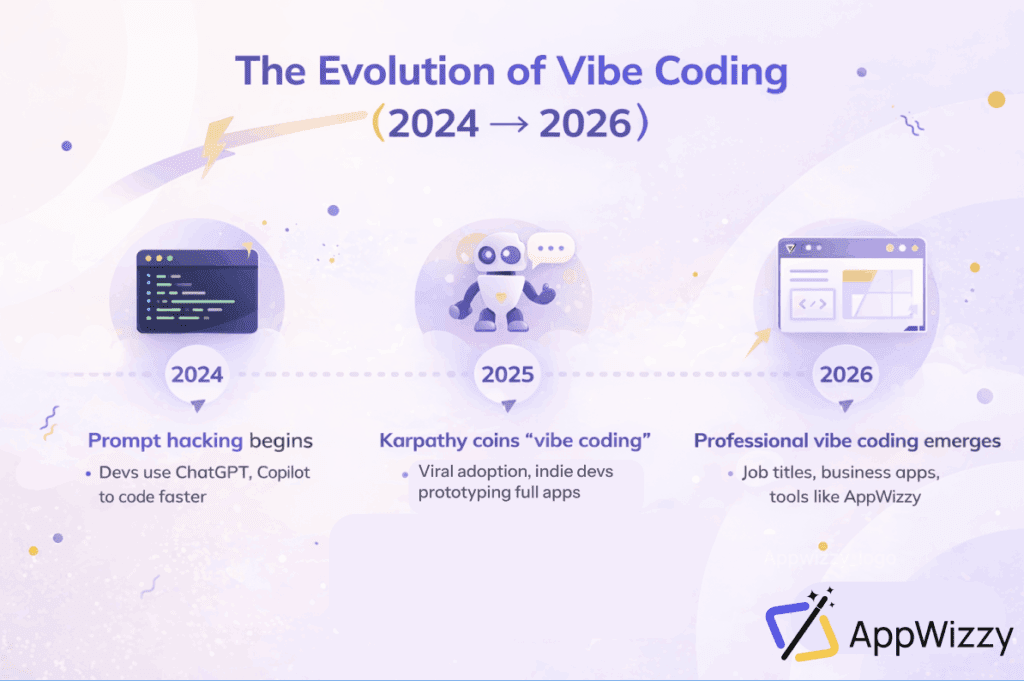
At its core, vibe coding means coding with intention and personality, not syntax. It’s a shift from how to code to what to build and why it should feel that way. The “vibe” in question can include:
- Visual tone (playful, minimalist, elegant)
- Copywriting voice (quirky, serious, luxury)
- Brand identity (colors, spacing, logo behavior)
- UX emotion (calm onboarding, high-energy dashboard)
- Developer intention (focus on speed, fun, clarity, etc.)
Vibe coding uses natural language as the primary programming interface. It’s powered by large language models (LLMs) like GPT-4, Claude, or domain-specific agents. It thrives on clarity of thought: the clearer your intent, the more aligned the AI’s output. In fact, a good vibe coder isn’t necessarily a trained engineer, they’re someone who can translate product vision into prompts the AI can act on.
The term exploded in early 2025 after Andrej Karpathy’s viral tweet: You fully give in to the vibes. You forget that the code even exists.
That moment marked the shift from prompt hacking as a novelty to vibe coding as a serious craft. By 2026, startups are hiring “Vibe Engineers” and “AI UX Coders.” These aren’t fringe titles anymore, they’re core to how fast, lean teams ship working software with soul.
Vibe coding is not just about aesthetics. It’s a pragmatic way to build:
- Internal tools without engineers
- MVPs without funding
- Full products without burnouts or backlogs
It’s also deeply collaborative. Your team becomes a set of vibe shapers: the designer shapes feel, the product owner defines outcomes, the founder guides emotion, and the AI assembles the structure. Code becomes the output, not the starting point.
In a world of infinite AI-generated sameness, vibe coding helps startups stand out. The ones who get it right don’t just ship faster. They ship things that feel alive.
Why Startups and SMBs Are Embracing Vibe Coding
Startups and small businesses aren’t just adopting vibe coding because it’s trendy, they’re embracing it because it gives them speed, personality, and power in a market that demands all three. In 2026, competition is fierce, user expectations are sky-high, and most SMBs can’t afford to burn months and tens of thousands on basic software. Vibe coding flips that script.
1. Build Faster, Launch Sooner
Vibe coding reduces the time from idea to working app by up to 90%. Instead of waiting weeks for wireframes, mockups, specs, and development, you can describe what you want and see it live in hours. Tools like Flatlogic AI, Replit Ghostwriter, and v0.dev make this possible by translating conversational prompts into working codebases. Founders no longer need to wait for “technical bandwidth”, they are the bandwidth.
2. Lower Cost, Higher Impact
For SMBs with tight budgets, vibe coding is a superpower. You can create internal tools, dashboards, and even customer-facing products without hiring a full dev team. AI takes care of the heavy lifting, and you only need human review and polish where it counts. This means $50K MVPs are now $5K side projects. Your marketing intern with product sense? They just became your next best prototyper.
3. Stronger Brand, Inside and Out
Traditional dev teams often default to functional but bland. Vibe coding lets you bake your brand identity into your software from day one, whether it’s playful microcopy, animated UI touches, or bold color palettes. The result? Apps that look and feel like you, not a generic template. Customers notice the difference, and they stick around because it feels right.
4. Empowered, Cross-Functional Teams
Vibe coding breaks down silos. A designer can build a prototype, a product manager can ship a live tool, and a founder can refine a feature, all without deep technical expertise. That’s because the barrier is no longer “can you code?” but “can you describe what you want clearly?” The new skillset is collaborative clarity. And it levels the playing field.
5. Rapid Iteration = Real Innovation
Want to test five product directions in a week? Want to spin up custom tools for one client without derailing your roadmap? Vibe coding makes this not only possible but expected. It aligns perfectly with lean startup principles: build fast, learn fast, ship fast. The faster you explore, the sooner you find what sticks.
Top 5+ Professional Vibe-Coding Tools in 2026
Here are the leading platforms startups and SMBs are using to turn vibes into real, working software. Whether you’re a solo founder, a product-led growth team, or a designer tired of waiting on engineering, these are the tools shaping how modern products get built.
Appwizzy
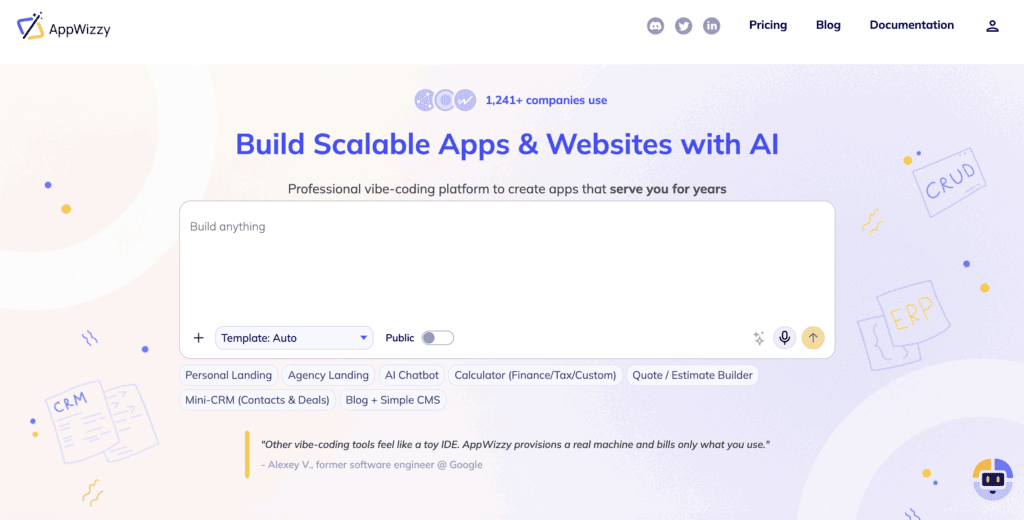
Appwizzy is the go-to platform for building full-stack business apps from plain language prompts, with a strong focus on brand, user feel, and structure. It’s not just a front-end builder or a playground for prototypes. Appwizzy creates production-grade SaaS platforms, CRMs, ERPs, and admin tools that reflect your company’s actual identity and logic. Its AI understands business flows, user experience, and even internal ops vibes, making it ideal for startups that want to move fast and feel premium.
Target Audience: Startups, SMBs, internal product teams, non-technical founders, solo tech entrepreneurs.
Key Features:
- Natural language-to-app generation (UI, DB, backend logic)
- Visual flow editor + full-code export
- Branded component libraries
- Data integration and role-based access built-in
- Human + AI hybrid support for refinement
Pitfalls: Requires clear prompts to avoid generic outputs; brand-heavy teams may still want human design polish.
Pricing: Freemium with $49/month Pro and $199/month Business tiers; custom pricing for enterprise.
Replit Ghostwriter
Replit’s Ghostwriter is an AI pair programmer built into the Replit IDE. While originally focused on helping developers write code faster, in 2026 it’s evolved into a true vibe-coding assistant, especially for solo devs and fast-moving startup engineers. It’s ideal for hybrid workflows: you vibe-code the scaffolding, then refine manually. Great for teams who like to touch the code but want 10x leverage from AI.
Target Audience: Indie hackers, startup developers, solo technical founders.
Key Features:
- Real-time code generation and refactoring
- Deploy directly from editor
- Multi-agent collaboration (AI + human roles)
- Auto-debug and test generation
Pitfalls: Not ideal for non-technical users; limited abstraction for business logic or UI style unless guided heavily.
Pricing: Free with limited AI; Pro starts at $20/month; Team plans from $75/month.
v0.dev by Vercel
v0.dev is an AI-first UI builder that turns natural language prompts into beautiful, React + Tailwind UIs. Perfect for frontend-heavy products, it helps designers, PMs, and engineers speak the same language, literally. The platform’s real strength is in generating elegant, branded interfaces quickly, then handing off to devs with clean, componentized code. It’s the “Figma-to-code” dream finally working.
Target Audience: Product teams, designers, front-end developers, UI/UX-heavy startups.
Key Features:
- Prompt-to-React UI generation
- Editable code snippets with design preview
- Brand tone control via prompt modifiers
- Shadcn/UI + Tailwind styling baked in
Pitfalls: Frontend only; no backend or database scaffolding; limited for end-to-end MVPs.
Pricing: Free to use in 2026 (Beta), with premium workspace features expected late 2026.
Lovable
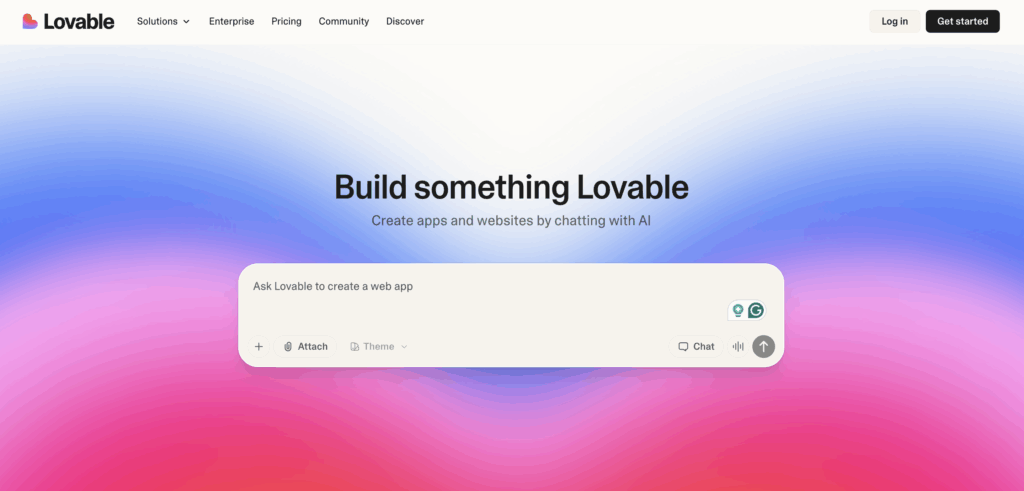
Lovable is a design-led, zero-code builder that feels more like Midjourney for product apps. Instead of focusing on structure, it focuses on feeling, you describe your product like a story (“a wellness dashboard with calm colors and motivational nudges”) and it generates a full interface that matches. Great for prototyping brand-heavy apps or internal tools with a human touch.
Target Audience: Non-technical founders, design-centric teams, wellness/education/lifestyle startups.
Key Features:
- Vibe-first design prompts
- Visual style memory across projects
- AI-generated copywriting and UI flow
- App preview without any code
Pitfalls: Limited control over logic/data; not ideal for serious dev handoff or complex business apps.
Pricing: Free tier with limited exports; Pro starts at $39/month.
Builder.io + AI Copilot
Builder.io has long been a favorite for visual CMS and composable frontends, and now with AI Copilot, it supports vibe-coded content blocks and UIs at scale. Ideal for marketing sites, headless CMS needs, and startups scaling across multiple brands. Builder’s strength is combining real-time design customization with clean, performant code output.
Target Audience: Marketing teams, DTC brands, SaaS with strong web presence.
Key Features:
- Drag-and-drop + prompt-based UI creation
- Connects to any headless CMS or API
- Personalization and A/B testing baked in
- AI Copilot suggests layouts and improvements
Pitfalls: Not built for backend logic or app workflows; requires dev support for custom use cases.
Pricing: Free tier; Teams from $25/month; Enterprise pricing on request.
CodiumAI / Codeium (for hybrid teams)
While not pure vibe coding platforms, tools like CodiumAI and Codeium are used by hybrid teams to vibe-check code quality, focusing on intelligent test generation, code reviews, and doc generation based on the “intended” behavior. Great for startups that use AI to build and maintain technical trust as they scale.
Target Audience: CTOs, lead engineers, fast-scaling product orgs.
Key Features:
- AI code review + intent checks
- Suggests missing test cases
- Explains code in plain English
- Integrates with Git and VS Code
Pitfalls: Doesn’t generate full apps; best for reviewing/refining.
Pricing: Freemium; Pro from $15/user/month.
How to Choose the Best Professional Vibe-Coding Tool for Your Startup
In 2026, the vibe-coding ecosystem is rich, but that also means it’s noisy. Picking the wrong tool can waste time, kill momentum, or worse, lock you into a workflow that doesn’t match your team. Here’s how to cut through the hype and choose the right vibe-coding platform for your startup’s DNA.
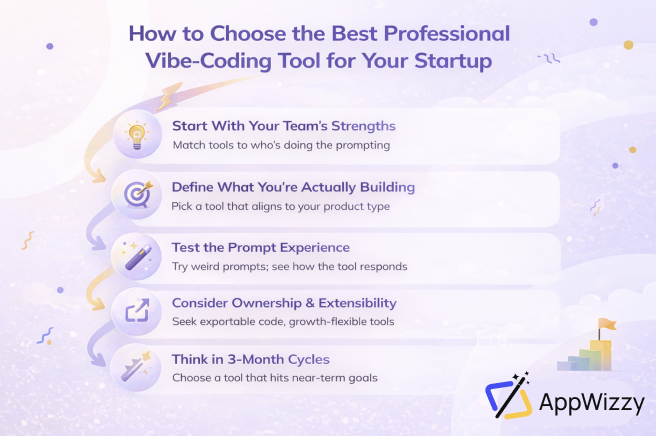
1. Start With Your Team’s Strengths
Ask: Who’s actually going to use this tool?
- If you have zero developers but strong product thinkers → prioritize tools with no-code UX (like Appwizzy or Lovable).
- If you have devs who want AI superpowers → go for hybrid AI coding (like Replit or CodiumAI).
- If your designers want to ship directly → focus on UI-first tools (like v0.dev or Builder.io). Don’t force your team to become something they’re not. Use vibe coding to amplify your strengths, not patch your weaknesses.
2. Define What You’re Actually Building
Not all tools serve the same purpose:
- Internal tools? You need database logic, roles, integrations → Appwizzy shines.
- Marketing or landing pages? You want layout flexibility + fast deployment → Builder.io is better.
- MVPs or SaaS apps? You need structure, auth, data, branded UI → go full-stack (Appwizzy or Replit). Match the tool to the type of product, not just the vibe.
3. Test the Prompt Experience
The core of vibe coding is how well the tool understands your intent. A good test:
- Give the platform a weird but honest prompt like: Build a dashboard that feels like a mix of Notion and Animal Crossing. If the result surprises you, in a good way, it’s a strong signal. If it’s generic, it’ll probably stay that way. The prompt interface is your steering wheel; make sure it’s responsive and flexible.
4. Consider Ownership and Extensibility
Great vibes mean nothing if you can’t grow with the output. Ask:
- Can you export clean code or are you locked in?
- Can developers jump in later to extend functionality?
- Can the tool scale with new data models, APIs, or auth needs? Tools like Appwizzy and Replit offer full-code access and extensibility. Others may give you pretty frontends but limited backend logic.
5. Think in 3-Month Cycles
Don’t overthink it. Choose a tool that can get you to your next milestone fast. You’re not marrying the platform, you’re using it to unlock velocity. A 3-month timebox helps:
- Can we ship something meaningful in 3 months with this tool?
- Will we learn fast enough to pivot if needed? Speed + learning > long-term planning at this stage.
The best vibe-coding tool is the one that makes your team feel unstoppable. Pick the one that lets you express your ideas clearly, build quickly, and inject your product with soul, not just structure. If your startup has vision but no devs? Appwizzy‘s your move. If your devs want to 10x output? Ghostwriter or v0.dev might be better. Just don’t settle for tools that kill the vibe.
Conclusion: Code the Vibe, Ship the Future
In 2026, software is no longer just built, it’s vibed into existence. The fastest-growing startups aren’t hiring more engineers; they’re learning how to speak clearly to machines that build for them. They’re shipping software that doesn’t just function, it feels right.
Professional vibe coding isn’t a gimmick. It’s a shift in how small teams compete with giants, how brand identity gets embedded in code, and how your clarity of intent becomes your most valuable technical asset. When done well, it fuses vision, aesthetics, and execution into one seamless workflow.
If you’re a founder, you don’t need to “learn to code”. You need to learn how to think clearly enough that code writes itself. You need to master describing your product in a way that feels like you, and let the AI handle the scaffolding.
Startups that ignore this trend will keep burning time and budget chasing tools that can’t keep up. But those who embrace vibe coding, intentionally, professionally, will move faster, connect deeper with users, and build software that actually resonates.
So don’t just ship. Ship your vibe.
Comments